The Eyesore
ZM
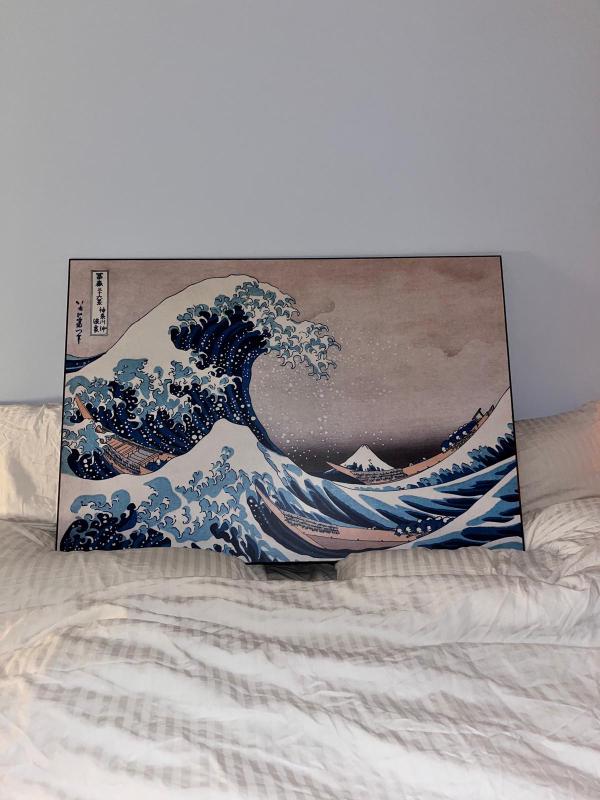
Three boats tossed around on treacherous waves. Fishermen hunker down on the boats in neat little rows. A wave rises, towering above them. It is really really blue and streaked white. The edges of the wave splinter and curl. In the hollow of the wave, the tip of a mountain rises up from the horizon. The sky is tea-stained with low white clouds. The wave is outlined, like a pen has carved out its crisp shape. The wave casts no shadow.
🌊🌊🌊🌊🌊🌊🌊🌊🌊🌊🌊🌊🌊🌊🌊🌊🌊🌊🌊🌊🌊🌊🌊🌊🌊🌊🌊🌊🌊🌊
I have just moved in with my boyfriend, into a flat that he bought a percentage of. We share the rent on the rest. We can do whatever we want to the walls (as long as the walls remain where the housing association put them). We polyfillered the cracks and sanded the walls pebble smooth. We painted the bedroom blue. And then I started to feel very queasy and nervous about living with a partner, about not having my own bedroom, about sharing an entire space with someone else. Because that space included the walls.
I know that my boyfriend has got an enormous print of Hokusai’s The Great Wave. It is huge, it is a meter long, it is flat and slightly shiny, it is printed on wood. The wood is thin, maybe a veneer? The print quality is quite good, it isn’t blurry or pixellated or fuzzed up. The edges are bevelled and edged in black like a built in frame. I hate it.
I haven’t ever properly looked at The Great Wave. But if I close my eyes I could recall the shape of that wave. It has been run-ragged from all the places it has been: copies, reproductions, postcards, conference rooms, offices, waiting rooms, MacBook default screensavers, emojis (🌊🌊🌊🌊🌊). It is everywhere, I am surrounded by the wave, I am the fishermen cowering in my boat and yearning for land. I am sick of seeing it because it offers me nothing. It is corporate-core, slop adjacent, banal stock imagery, white noise, there to fill space and decorate the peripheral vision, it is mass. And this print is jarg, printed bigger and shinier than the actual original. It has no charm. It is an affront to everything I have dedicated my life to: I care about the weird wonderful things people make when left to their own devices, I care about visual culture and the images that have existed throughout history. This print of The Great Wave is not art made by a person, it is a product that has been manufactured by a machine to a technically high standard.
🌊🌊🌊🌊🌊🌊🌊🌊🌊🌊🌊🌊🌊🌊🌊🌊🌊🌊🌊🌊🌊🌊🌊🌊🌊🌊🌊🌊🌊🌊
Back in 1831, Japan was enjoying a period of stability. The Shogun ruled from Edo (now Tokyo), the largest city. Trade and culture had flourished. Provincial lords had encouraged local crafts, as a way to bring money into their region. And in Edo, a pleasure district had opened for commoners with disposable income. This new merchant-middle class had money and time to spend on hedonism, pursuit of pleasure and recreation. This world of pleasure had become known as ukiyo, the floating world, and a popular culture formed around it. Theatre, music, literature, poetry, and a distinct genre of visual art: ukiyo-e (pictures of the floating world). Woodblock prints of geisha and courtesans, actors, great beauties. And later, landscapes, scenes of everyday life. By 1931, this artform was a proper operation. Artists would design the print and hand it over to a woodcarver to cut the woodblocks, then to a printer to ink and press the blocks onto handmade paper, then to a publisher to promote and distribute the prints. Full-colour was standard by then, with multiple blocks being used for one print. Since they were always printed by hand, artists could be ambitious, use blended colours or gradients. Each image could be endlessly re-produced, until demand died down or the woodblocks wore out, so they were relatively affordable. And in depicting this familiar world of pleasure, recreation and lovely things, ukiyo-e prints became popular home-decor for Edo’s pleasure-seeking merchant-middle class.
Back to 1831. By this time, ukiyo-e artists are less interested in endlessly depicting hedonistic luxury, now they’re producing pictures of nature. Birds, flowers, landscapes are their own popular genre. And Katsushika Hokusai is already a celebrated artist. He produces a series called Thirty-six Views of Mount Fuji, which includes The Great Wave off Kanagawa.
Out of all the works in that series, the Great Wave becomes one of the most famous works of Japanese art. I’m not sure why (in my unsolicited opinion, other works in the series are much more visually compelling), but I can speculate. In this series, Hokusai uses a pigment called Prussian blue, rather than Japanese indigo. Prussian blue is very resistant to fading, unlike indigo, because it’s synthetic. So this print is like, really BLUE. He was also using linear perspective, golden ratio, compositional techniques that Western viewers favoured (it spoke in a visual language already familiar to them). He’s engaging with themes and subjects also familiar to Western audiences in the 19th Century: Romantic ideas of the sublime, the power of nature and the smallness of man, the lives and environments of ordinary people (like fishermen). There are bold, flat fields of colour — the image is so simple, it is almost abstract. Through the 17th and 18th centuries, Japan was not open to foreign trade or influence. There was some trade with the Dutch and Chinese, but only in Nagasaki. In 1853, the American Navy sent a fleet of warships and forced Japan’s ports to trade at gunpoint, ending their isolation. Amongst other things, ukiyo-e prints flooded into Europe and America, becoming popular, inspiring painters (like Van Gogh, Whistler, Gaugin, Monet etc). The cultural popularity of Japanese art became known as Japonisme — the 19th and 20th century equivalent of weeaboo-ism.
🌊🌊🌊🌊🌊🌊🌊🌊🌊🌊🌊🌊🌊🌊🌊🌊🌊🌊🌊🌊🌊🌊🌊🌊🌊🌊🌊🌊🌊🌊
It was Kitsch, in a classic Greenbergian sense. Mass produced, vernacular or vulgar, sentimental, earnest, eccentric or naive. It was pop-cultural, commercial, made to be sold, made to be popular, enjoyed or loved. Both this wider category of ukiyo-e prints and The Great Wave as a singular image. Ukiyo-e prints were handmade and mass produced images made to decorate middle class homes. The Great Wave has been copied and reproduced in so many ways, it has ceased to function primarily as an art-image — it is now a symbol (literally 🌊), we are more familiar with it as a reference point for other things.
And here is the truth: I’M A SNOB. Worse, my snobbery is self-reflexive. I’m a snob about how my snobbery expresses itself. I don’t hate that The Great Wave is a mass produced edition. I don’t hate that it was made to be sold, or made to be sold to middle-class, non-noble commoners. I don’t hate that it was made to be decoration in homes. I don’t hate that it is clearly well-loved, pleasant enough to look at that 200 years on people still want to put it on their walls. I don’t hate that it is kitsch! I don’t hate that it is popular, identifiable to people who don’t know or care that much about paintings. I don’t even hate that it was made, arguably, with the West in mind. That kind of snobbery would be deeply unsophisticated.
I hate The Great Wave because it has been replicated too many times. In being reproduced it has been altered, and the original now seems uncanny, it seems to have shrunk. It is instantly recognisable, so much so, that I have never even bothered to look at it — why would I, when I already know what it looks like?
🌊🌊🌊🌊🌊🌊🌊🌊🌊🌊🌊🌊🌊🌊🌊🌊🌊🌊🌊🌊🌊🌊🌊🌊🌊🌊🌊🌊🌊🌊
What do people put on their walls, when given the freedom to put things on walls? What goes into choosing what you put on your walls? Is it about what you find in shops, is it about what you like (or love forcefully enough to want to look at it everyday), is it about signalling taste or class or cultural expertise? Can you can signal (taste, class, cultural expertise) to yourself as well as others? And what kind of psychic relationships are we building between ourselves and these images we look at every day?
Don’t you think it is very weird that in these inner-circles of the art world, the paintings that are recognisable to people in the wider world have no potency? It’s like in being recognisable, popular or well-known, an image becomes obvious and therefore emptier. The Mona Lisa, Matisse’s Blue Nudes, Monet’s Water Lilies, Van Gogh’s Starry Night. If everyone knows about it, we (in the art world) don’t bother thinking about it. This is SNOBBERY! It’s obvious, uncomplicated, explicit snobbery. It’s the snobbery of everyone wearing Adidas Sambas, of a trend cycle hitting the mainstream and dying because no one chooses to be basic. But why do popular things feel banal, why does obscurity confer value, why do I want to be special and not like the other girls? If I agree that snobbery about popular things is elitist, why do I still hate my boyfriend’s meter long wooden print of The Great Wave?
🌊🌊🌊🌊🌊🌊🌊🌊🌊🌊🌊🌊🌊🌊🌊🌊🌊🌊🌊🌊🌊🌊🌊🌊🌊🌊🌊🌊🌊🌊
I have never properly looked at The Great Wave, but right now as I am writing, I am my sat in front of my boyfriend’s meter long slightly shiny wooden version of it. I am looking at it. I am ignoring that I hate it. My opinion is irrelevant to this prolonged act of looking and attempting to actually see the image.
A wave coils, ready to spring — rearing in from the left. It is frozen in mid-air, mid-leap. The crest of the wave is foamy white, curling like fingers or claws or teeth. There are so many of them, it feels ornate. There are watery pale blue shadows around these claws, so they feel hi-def. The wave could be a mountain. It is marbled with these dynamic white streaks. They make it pulse, alive, like there is movement or power. Yes, power. It is like the wave is alive and takes pleasure in exercising its enormous power. Three ships skid around under the crest, at the wave’s mercy. They disappear, half tucked under the wave and its swell. The fishermen on the boats are cowering in neat rows. You can see their bent backs, the curve of their downturned heads, the oars clasped to their chests. There is something sweet and sad about their smallness. The water sprays them in a shower. The claws are ready to tear into them. The snowy tip of Mount Fuji looms silent on the horizon. It is a stoic little pinch. I think the fishermen yearn for the land, but the mountain has more in common with the wave. The sky is blushing beige, low white clouds flecked with spray over a darkening horizon. This image is violent. The water is all sharp angles, pointing and impending, waiting to crash down and swallow the boats whole. This image is cartoonishly violent. The boats and the men look so flimsy, so weak. The wave is outlined, crisp, clear, definite. It casts no real shadow on the world, but the claws seem to flex the longer I look. It feels like everything is teetering on an edge. Like the action is just about to kick into gear. This image is a kind of cartoon. The blue of the wave looks syrupy dark and solid. The outlines and colours are so flat and simple, so matter of fact. The lines on the claws are harsh and sharp. Everything in the image looks like it has been this way forever. It is violent, but neat. A discrete little pocket dimension, a window we are peering into.
My boyfriend walks into the bedroom where I am staring at his meter long slightly shiny wooden print of Hokusai’s The Great Wave off Kanagawa. He is smiling at me. He is pleased.