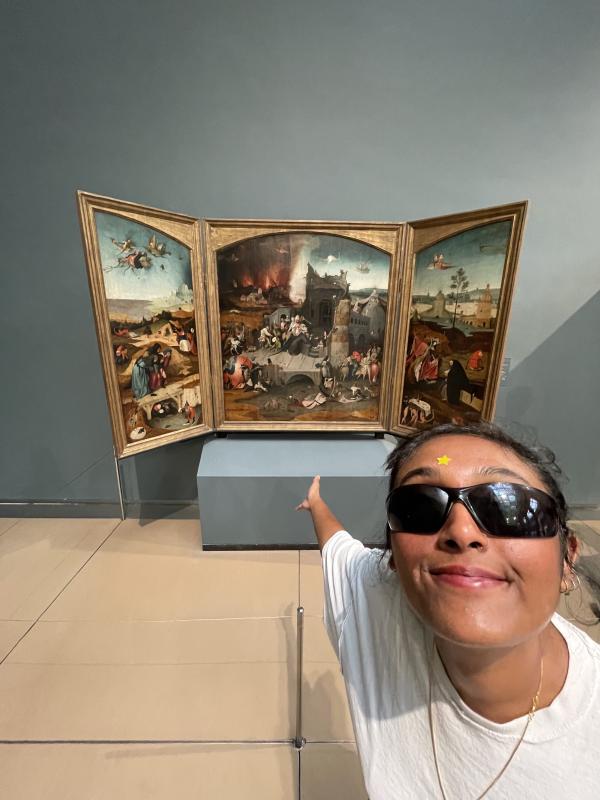
Triptych of the Temptation of St Anthony
ZM
I am half-snoozing against the glass of the train window as it cuts through the flat expanse of the lowlands. Fields all green and yellow in the heat of summer, the sky is white and bruisy with clouds. It is so early in the morning. My heavy eyelids, I can see all the way out as the fields disappear into the grey horizon.
Just saying I’m an art critic feels like I am being too vague. Sometimes I am a crazed stalker, a fan. Sometimes I am a pilgrim. I like to write about things I enjoy, but I try not to write about the things I love. Love can fall apart when it is closely inspected. I find that the mystery is part of the appeal.
Four years ago, in Lisbon, I attempted a first version of this pilgrimage. I set out to the Arte Antiga to find a dusty hole where this painting was meant to be (and a sign saying it was on loan in Milan). When I got home I searched for flights to Milan, to find that the show had closed anyway — I imagined it in a backroom somewehere, in transit. No worries, a good pilgrim is patient.
Now, speeding through the Belgian countryside, I am on my way to narrative closure. My sister is asleep next to me, her head on my shoulder. We are both on a pilgrimage, you see. She is wearing glitter on her nose. Tonight she will be in the crowd listening to a k-pop boyband, reunited and fresh from military service. Tomorrow morning she will show me a video on her phone — Jungkook walks right past her, fireworks popping in the blue sky above, and my sister is screaming like the world will end when the song is over. She is making a sound I have never heard coming out of a human being before and I laugh because — how lovely! To love something so much it makes you howl like a crazed wolf.
In Brussels, the Museum of Old Masters has a workshop copy of Hieronymous Bosch’s Triptych of the Temptation of St Anthony. I obviously know that this is not the original — that’s back in Lisbon now. But the copy in Brussels was still made in Bosch’s workshop, around the same time as the original, it is mostly the same (except for the frame). I don’t care too much about the aura of the original. I just want to see the object of my affection.
Because even before I set out as a pilgrim the first time, I knew what this painting looked like and I knew that I loved it. St Anthony the Great, the first monk. He lived in the 3rd Century, a hermit in the actual desert. The devil sent demons to scare him, gold to tempt him, naked women to test his faith. Angels carried him through the air and mid-flight he was ambushed by winged demons who pull at his hair and his beard. He is the patron saint of skin diseases, brushmakers and gravediggers — and Medieval Europeans were obsessed with painting the vision of his temptations.
In Bosch’s version: St Anthony rests at a well. A vision of Christ on the cross before him, he turns to gesture at this miracle. Hell’s creatures spill out around him, in chaos and fully fledged nightmarish form. A tiny capuchin monkey riding a fish in armour, a rat in a robe holding an owl, a man that is also an upright rat is playing a lute, a devil (with hooves and a face like a donkey) playing the harp, a parrot playing cards, a tiny grey imp weilding a sword, bursting out of a giant tomato, a toad with a man’s face, a tree in a bowler hat, a creature that is a white head on legs with wings and fangs, a priest wearing pink robes gestures to a man with a tankard for a head. Birds that are boats skim through the waves of the sky. The flat fields of the lowlands behind them, the village is on fire. Also, all of this is happening in, what looks like, a ruined tower. There’s a bridge behind, disppearing into a bulbous building where people are (if I squint, I think they’re) fucking. On the right panel, a couple ride a flying fish through the sky, a naked woman peeps through a curtain at St Anthony (who is reading a book and turning his head away). On the left: a crowd of robed devilish creatures hold up a single fried egg, a gnome with a hat bends over and shits out a branch, a fish in a shell, a man slips under the grass and raises a hill, all as St Anthony limps along the road held up by a group of monks and men.
I don’t want to say what I love about the painting, why I love it. It’s not that my love is fragile, it’s that love is full of secrets. Love is exactly as Lauren Berlant said, it changes without guarantees. Love is throwing yourself into relationality without fully knowing what’s on the other side. I think the secrets are the point! Sometimes writing makes sense of things, it fixes things down or slows it for long enough that I can pair the feelings up with words and — in order to do that I have to, in some way, bring it to a point of rationality. But I can’t love something rationally. Secrets are irrational, mystery is irrational, love is irrational!
If I think long and hard, I can formulate a question: is there a form of writing that doesn’t rationalise? An irrational voice, that is capable of transmitting the energy of dreams and visions and nightmares, of love that throws itself without knowing —
I have this dream: I wake up from a dream, my eyes are still closed and I am snoozing. Little creatures (the size of tube mice, black and sinewy) roam over the bed around me. I can feel the movement of their skittering legs. They have long roving antennae that twitch as they commune with each other. They plod up from my feet to my face and I wake up in the dream, scream, then wake up in real life — sometimes I am screaming, sometimes not. This is more like a dream suffix. I have other actual dreams that I wake up from into that one, and it acts like an interstitial jumpscare. A jolt upright, to make sure I’m paying attention. I wake up screaming (or not). It is only a fear of bugs. One night I was actually woken up by an actual real life bug crawling over my face, roaming in and out of my right nostril. I screamed, sat up, looked down at my pillow in the dark and saw a black blob gliding across my pillow. I dream of interstitial bugs whenever I sleep with the window open. It is interesting that this what my brain does with the memory. I don’t understand how, or why, I cannot control it. But it has made the horror into a kind of magic. The interstitial bugs are cute, in their own weird way. They scare me awake, but I laugh myself back to sleep. They leave sooty footprints all over my sheets, I feel the vibrations of them and wonder what they are saying, to each other or to me.
I am a pilgrim on a pilgrimage to a painting. My sister is a pilgrim on a pilgrimage to a concert. When she gets out the other side she will have a new tour hoodie and loads of photocards and a bracelet that a girl in the crowd gave to her because her kind of pilgrims make little gifts for each other. Back in Medieval times, a pilgrim on the Camino would get a scallop shell pin to identify themselves as a pilgrim. They’d get a metal token or a prayer stone or little coins. Maybe the monasteries and churches they passed along the way would stamp their little pilgrim booklet. I wish painting pilgrims got little badges to demonstrate the efforts and lengths they had been to, a token of their affection. Tonight, when I get to the Old Masters Museum, I will just have to buy a postcard. A Christmas ornament, if I’m lucky.
I worry, sometimes, about what I would do if God turned out to be real. If I died and woke up to trumpets on the day of judgement. I am meant to be Muslim, but I have a strange way of going about it — not least of all, in my love for the graven image. What would I even say? If an all-powerful creator asked me why I went on pilgrimages to go see paintings, instead of going to Mecca. I like to think he wouldn’t mind too much, that he’d understand. I like to think the mystery and the secrets of love are the mysteries and secrets of faith. The most interesting questions don’t have easy answers, and I really believe: that it is more interesting to not know.