
Stonehenge
ZM
I am in the Stonehenge car park looking out at the surrounding fields. All the long grass is bright yellow, like piss. There are tiny little crispy wildflowers, I can see them when I squint. Some of them are dark purple, some are brown and crumbling. A man in wraparound sunglasses is smoking under the boot of his car, a woman in an English Heritage polo shirt comes up to tell him to put his cigarette out properly — wildfires you see, he shouldn’t really be smoking at all but, what can you do.
Piss yellow as far as the eye can see, all the way out to the horizon. I cannot believe my own eyes. It looks like something from a film, maybe a dystopian future, or some apocalyptic vision, zombieverse — as I am thinking these trite thoughts, another thought interrupts to point out that I am just trying to find a likeness to explain something I find incomprehensible. I think then about the water wars. I think about Mad Max and Immortan Joe turning on the big skull shaped tap in the citadel, the water rushing down onto the dusty peasants in the nuclear waste of the valley below. I think about the stillsuits in Dune, the abject horror of drinking your own (evaporated and then condensed) sweat. I think about Nehru’s dam building project in post-independence India, and how those upstream dams take seasonal turns, flooding and drying up the rivers in Bangladesh, where my Dada was born. I think about the false autumn in London Fields, all the trees shedding their leaves in August, covering the park and crumbling to dust under my flipflops. I have been dreaming of a glacier. Sometimes I climb up it, sometimes it is a bouncy castle and I jump up and down on it in my North Face puffer jacket, one time the glacier was a giant cake — I tore into it with my hands to find Victoria sponge under the icy white icing.
Apparenly Stonehenge has been here, on the Salisbury Plains, since around 3000BC. But ancient Stone Age people lived here long before that. The fields around me used to be woodlands, those Stone Age people chopped down trees, dug ditches and banks and levelled out hills into long flat plains. Archaeologists found hand tools made from the antlers of red deer — because, remember, they were doing all this before metal. They also left evidence of older standing structures, right here under the tarmac of the car park — postholes for pine logs, dating all the way back to 8000BC.
Years back, I worked at a travel agency for the super-rich, booking flights and fancy Ubers for Dua Lipa and Bill Gates’ son. One of the girls in the New York office came to London for training and she told me she was so excited to be in Britain because she was obsessed with British culture and all of its little quirks and oddities. I asked her what she was going to get up to while she was here — very ready to roll my eyes at the American in London bingo card (Buckingham Palace, Tower of London, Oxford Street, afternoon tea, red phone box, black cab, Paddington bear, policemen with their funny little hats). She said she’d booked a coach trip to go see Stonehenge. She asked me if I’d ever been, she was obsessed — it’s sooooo British, I love it.
In her book, Finding Albion, Zakia Sewell searches for ‘an alternative spirit of Britain’. If a nation is a made up thing (a social construct, pure arbitrary fabrication) then what goes into the making? It is symbols, myths, folklore — the stories we tell each other about our selves and the way we put those stories into practice. In short, it is culture. Not the formal kind of culture that lands in galleries and museums, but the culture of people (in their homes, in their halls, on their streets, in their lives). In Finding Albion, Sewell notes that we are living through a kind of folk revival. She goes to Glastonbury for the Spring Equinox, she speaks to Morris dancers (young and old), she beats the bounds of her grandparents’ village, she goes down to Penzance for Montol (a revived pagan festival of chaos) — she also goes to Notting Hill carnival, traces folk culture’s journey along the routes of the Empire, she speaks about poaching and enclosure of the commons. It is a quest for those exact stories — mystery, magic, myth — the culture of people in their homes/lives/streets.
In one early chapter, Sewell makes a point that I cannot shake out of my brain: when it comes to Great Britain, Scotland and Wales have got a pretty codified sense of their own folk culture (tartan, caelidhs, bagpipes, daffodils, bardic poetry, red dragons etc). But England got lost somewhere in the imperial project of becoming Britain. Most of the symbols and images we think of as traditionally English are symbols and images of state power: the monarchy, policemen and their little hats. It’s either that or it’s a lie: England’s green and pleasant land, the countryside as a kind of toy town theme park, butchers’ aprons and st George’s flags — the imperial nostalgia industrial complex, trying to trick us into believing that the rose-tinted past can come back if we all will it forcefully enough. None of those images speak of people and practices.
The Visitor Centre at Stongehenge is a massive looming metal spaceship. In one wing there’s a museum display: the antler picks, bone fragments fashioned into hand tools, pottery fragments from the ancient neolithic beaker people that settled across Britain. Then there are little models of Stonehenge through time — a series of concentric circles across a field— first wide, then small, then layered into each other, round a horseshoe, round the slab of the altar stone. Slim wooden posts, then big hulking stones interlocking.
Some of the stones came from nearby, some came from Wales, the altar stone in the very centre came from Scotland. We don’t know why they built it, we don’t know what purpose it served for them or what it’s meant to even be. I don’t think they can even figure out how it was built. I mean the theory is, they rolled the stones. Either on logs or on a sleigh greased with animal fat. I imagine the slippery log trail running the full length of the Great British landmass, from Orkney to Wiltshire, and the scale of it all makes me feel woozy.
And there are theories about the purpose, but I still want to know why! Was it some kind of religious site, or was it political? Was it used for rituals, festivals, communing, parties — what were they up to? The map in the visitor centre has got these little bedazzled green blobs: barrow tombs and burial mounds. Archaeologists have found grave goods like daggers, bits of leather, pots and arrowheads. The wider Stonehenge site includes an Iron Age hillfort, a flat path out to the River Avon, flat strips of land North and North East of the stones, and the walls of a settlement, some Neolithic village. But the people who built and used Stonehenge left no written records. For the most part, the thing remains a mystery.
In her search for Albion, Zakia Sewell’s last stop is Stonehenge for the Spring Equinox (when day and night are bang on 12 hours each). She joins a crowd of pagans, druids, hippies and crystal healers as they bang drums and greet the rising sun. Sewell notes that, sure, Stonehenge is a mystery but, as with all mysteries, we learn about ourselves as we try to fill the gap. Each era has pulled out theories about why/how those stones are there. It doesn’t matter if it’s true or bogus, because we can glean information about the era that produced those theories.
In the C12th, Geoffrey of Monmouth reckoned the stones were magically transported from Africa by the wizard Merlin, as a monument to the ancient British noblemen murdered by Saxon invaders. In The History of the Kings of Britain, Geoffrey wrote about the Saxons as a barbaric hoarde of invaders, valiantly fought back by King Arthur. In C17th and C18th, gentlemen antiquarians studied and measured the stones with the studious intentions you’d expect from the Enlightment era. They found that the stones are aligned with the direction of sunrise and sunset at the summer and winter solstices. The sun rises/sets directly over one of the stones and shines through the horseshoe right down into the centre. In the C19th and C20th, industrious Victorians etc thought of Stonehenge as a giant astronomical observatory, built so astronomer-priests could observe and catalogue the movements of the heavens.
In the 1970s and 80s Stonehenge was the centre of a new-age hippie counterculture. People dropped out of formal society, travelled the country in vans, going from communal site to communal site, throwing free festivals along the way. Cold War apocalypse in sight, if the end was nigh then fuck Thatcher, fuck Reagan —why not strike out and try to reimagine what the world could be? In the Blair years hangover (the 2012 olympics and all that public spending), Jeremy Deller made a life-sized inflatible bouncy castle Stonehenge. Sacrilege was an artwork ‘about Britain and our history and the idea that we can play with it’, or bounce ourselves off the face of it, ‘if we want to’. For that melting pot multicultural version of Britain, Britishness was open for everyone to get stuck into and muck around with.
In 2024, an archaeologist called Mike Parker produced research revealing the altar stone’s Scottish origin. He suggested that — with the stones coming from Southern England, Wales and Scotland — maybe Stonehenge was built to unify Britain’s various inhabitants. Maybe the site played an important political purpose, as new groups (like the Beaker people) migrated to Britain from the continent. Of course, the right wing press found that very salient (GB News described Stonehenge as a monument built to ‘unite indigenous people against foreign arrivals’). Sewell herself responds to this all with her own theory: foreign arrivals bring new cultures and ideas, this is a good thing. When the Beaker people arrived in Britain they lived side by side with the pre-existing inhabitants, bringing metalworking skills, pottery, archery, catalysing the transition from the Stonge Age to the Bronze Age. There’s evidence that ‘although their ancestors had not built Stonehenge, [they] used it for roughly 500 years, burying their dead and adding new layers of meaning to the site, developing a kind of hybrid culture’. As far as I can claim to, over the course of reading Finding Albion, I have got to know Zakia Sewell a little. She strikes me as someone who thinks of culture as something that is very much alive, something that we make together (as people, in our lives, on our streets).
A bus runs from the visitor centre to the stones every 10 minutes. When I step off it, the midday heat is nuclear. Not to wimp out on some kind of finale of critical judgement — but I think the mystery is the point. Speaking to Sewell, Jeremy Deller says ‘Stongehenge provides a big open space, metaphorically and intellectually, where we project our ideas about Britain and ourselves’. I look at Stonehenge and I see what I want to see.
Piss yellow fields blaring in the corner of my eye, because I am scared that we will all get fried alive in our newbuilds if this is every London Summer. Remembering how I scoffed at the sweet girl from the New York office because, back then I would rather have been dead than British, but in my 30s I inexplicably find myself trying to negotiate a relationship with Englishness (even though I’m well aware it’s worse than Britishness). Cyclists gawping on the public footpath and the motorists dawdling down the A303, I’m wondering if it was really worth £30 to stand within spitting distance from the stones.
Because, I think the most British — no, English thing about Stonehenge is that it’s owned by the Crown Estate. It was gifted to the nation by a rich barrister, who bought it from a baron who bought it fom a duke who bought it from another duke who bought it from an earl. It passed to the earl when he married into the Seymour family — they were given it by Henry the literal eighth. Stonehenge has been owned by the crown all the way back to Alfred the Great and before that, I don’t think they were keeping records of that kind of thing — I am not joking. Yes yes, now it is run and managed by English Heritage and the National Trust, you’ll see their logos all over the info leaflets. But Stonehenge belongs to Charles because his blood is more special than everyone else’s and so he gets to be King, or The Crown, a legal fiction that lets us all ignore the fact that we still basically have feudalism.
England doesn’t get to have fun national symbols, England doesn’t have a national identity for us to all slot into, England doesn’t exist because England is just private property, given by the King to his most favourite best boys. England exists to protect private property — in 1985, the hippies arrived at Stonehenge for a free festival and were chased through nearby fields and hedgerows by police. Police smashed the windows of the hippies’ vans, clubbed anyone in arms reach including pregnant women and babies, set fire to caravans and flung everyone into riot wagons. That’s what you get for daring to dream of an alternative. England doesn’t care about the English (newly including little old me) because we are just limpets clinging on to the King’s special rock. That’s my theory. But I only think that because I live in an era of English misery, and I believe we’re about to crash headfirst into our second serfdom (in this one, we’ll be tied to the lord of the manor’s server farm).
But here I am, on the piss yellow fried grass of Salisbury Plain. Spitting distance, staring up at the honking great stone slabs of this thing, dying itching burning to reach out and touch Stonehenge. I do not want a King, a lord of the manor, or private property, I want a culture. I want to join Zakia Sewell in her quest for an alternative spirit of Britain. I want to revive some folk custom on a flimsy excuse to get people together. I want a culture that is alive! at any cost. Beat the bounds round the London Borough of Hackney in homemade costumes, bagsy coming as a Flat White. The giants, Gog and Magog that defend the City of London, we can stand on each others’ shoulders and pretend to be them. Dance in the tunnels at a free festival in the dead tube stations. Homemade boat regatta down the full length of the Thames, you get a medal if you make it to Greenwich dry. We can just steal from the good people of Siena (same as we stole our flag from the Genoese) and do our own Palio, race lime bikes round Trafalgar Square or through the District line’s carless carriages. I’ve seen the unions marching down to Aldwych with their banners for the May Day Parade, the Brazilians with their pots and pans yelling free Palestine.
Britain or England has two versions of itself. A glorious past we preserve in aspic, unchanged because it came from an era where we owned half the world. A future we are hurtling into together, a mystery for the most part, but ours to construct as we please. Culture has to be alive for it to mean anything! Aspic only delays an inevitable rot, we cannot stay still forever, hoping the past will mean something to us in the future. The other week I was at a wedding and the bride and groom’s entrance song was Rihanna’s We Found Love, but a remix with four live dhol players. When the beat dropped the drummers emerged from the four corners of the room, fireworks exploded, the crowd went crazy. Universal banger accompanied by an Asian drum played for the harvest moon. We bring our old cultures, add new meaning, make a hybrid that catalyses a transition into a new era. That is alive and kicking.
I can see why people look back this far in the past for a culture to drag forward and resuscitate. Albion is a vision of England before Empire, capitalism, private property, kings, or and even England itself. There is so much we don’t know (what, how, why), it is a mystery. In Finding Albion, Zakia Sewell makes a compelling case to abandon perfectly preserved/rotting traditions, and to start working ourselves into the gaps left by the mysteries.
Fried grass, honking great stones. I am chanting rhythmic nonsense at the back of my sister’s head, whispering ‘to open the portal, the stones demand a blood sacrifice!!!!!’ Because I LOVE THE MYSTERY! The mystery is the point, the mystery leaves space for us to throw something back into the gap, it is the silence in the conversation that gives you room to think before you open your mouth in reply.
Stonehenge has been there for 10,000 years so it is funny to think of it as having tickets and an opening time – i’ll say that you can fully see it from the motorway and/or the public footpath, but if u wana get spitting distance then book in advance (you save like 25%) online from English heritage’s website. Zakia Sewell’s book Finding Albion is very good, rather than leave a link i’ll recommend getting it from ur nearest independent bookshop (but if not, then bookshop.org is v good)
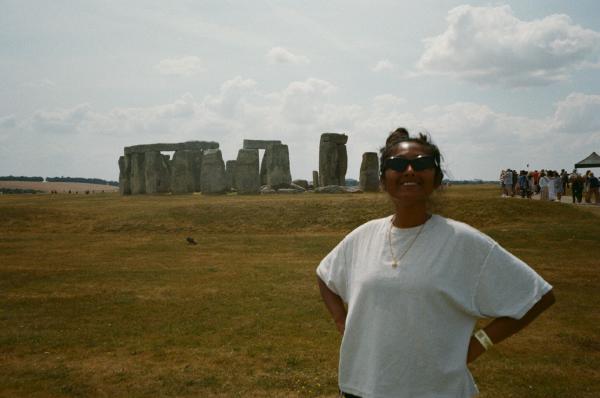
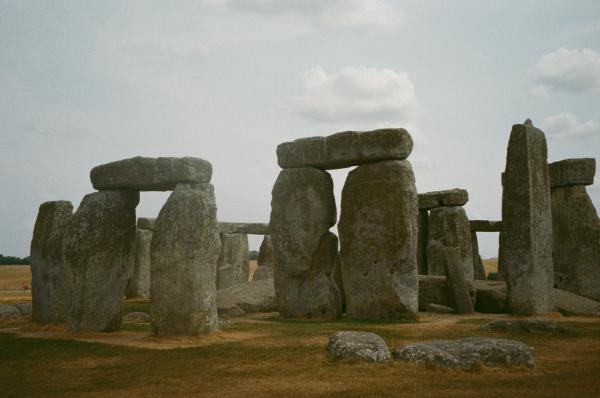
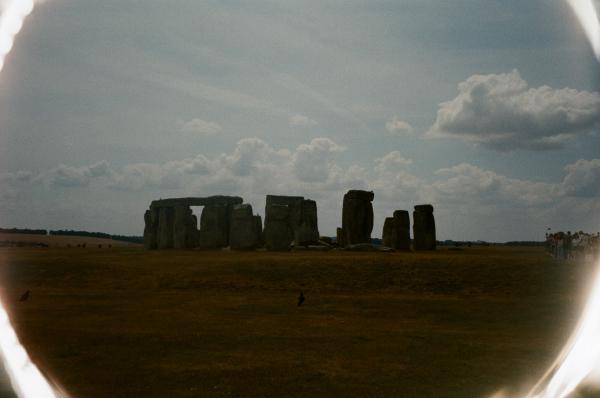
if the taxman asks, thank u to the uncles at eyeculture on bethnal green road for studiously developing the piccies on the definitely expired roll of film i handed them. using them here means it is now a tax deductible expense, thanks.