Hurvin Anderson
ZM
It is rainy January and I am looking through the UAL staff portal for a well-hidden form. If I fill in this form, I can get a free place on any UAL short course. I book myself into a week of oil painting. It is rainy April and I am in a studio round the side of Chelsea unpacking a half price Cass art multipack from my tote bag.
See, I used to paint. I applied to art school with a portfolio full of paintings, but by the time I actually got there, painting had started to feel embarassing (and boring). I wrote scripts, made films, packed it all in, became a writer instead.
But now, rainy April, I am in a studio and I am pushing paint around with my brush. I am mixing things into my paint, making the paint feel like chewing gum. I am making the colour stretch and slide. I am painting my sister’s face, but making her bubblegum pink (because it is my painting, I can do whatever I want). All my desires are fulfilled or fulfillable. I am having a really really good time.
Painting taught me you can look at the world and see it — fine. Or you can look at the world and see the possibility of an image. An image wasn’t something that landed in my lap, it was a premeditated thing I searched for. I make my eyes go fuzzy and out of focus. I imagine my field of vision is a little box, I rearrange everything in front of me by putting it in the box. I look at the space between the things, I stop seeing the things as things, I see them as shapes, lines, colours and collections of tones in relation to each other. I see depth as a matter of order. The world is a collection of shapes that exist on top of each other. My vision becomes a realm-to-be-mediated.
Back in olden times, the job of a painter was to be a kind of optical illusionist. The painter could deploy a wide variety of technical strategies to make a bunch of grapes look juicy and real. I reckon it is more like a magical power than an art, because a painter can just conjure up an image from scratch while everyone else is scrabbling around looking for materials and contraptions.
Painting has a weird relationship to truth, where truth is a sliding scale: transcribing the world faithfully (realistically) »> bending the laws of time and space so a bunch of grapes can be juicier. Even when photography came along, when cameras could produce realistic images of things and the world, it clarified that that wasn’t really the point of painting (so painting continued to exist, the illusions got weirder, wilder).
When I talk about every other kind of art, I guess I talk about concepts and discourses and critical dialogues. When I talk about paintings, I talk about something that feels parallel, close enough, but not the thing itself. It is a language of similes. This painting looks sunburnt. This painting looks like it has arrived recently from outer space. Paintings resist words (words being our attempt to regulate chaos). There is no suspension of disbelief, we know we are playing, the best we can do is find likenesses. Speaking this language of similes, we often reveal more about ourselves than we do about the images. Paintings force us to the point of projection.
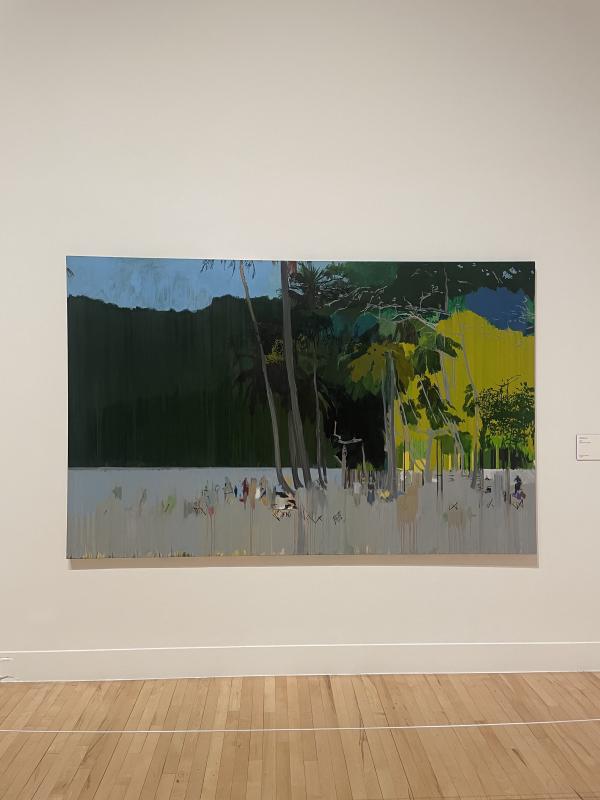
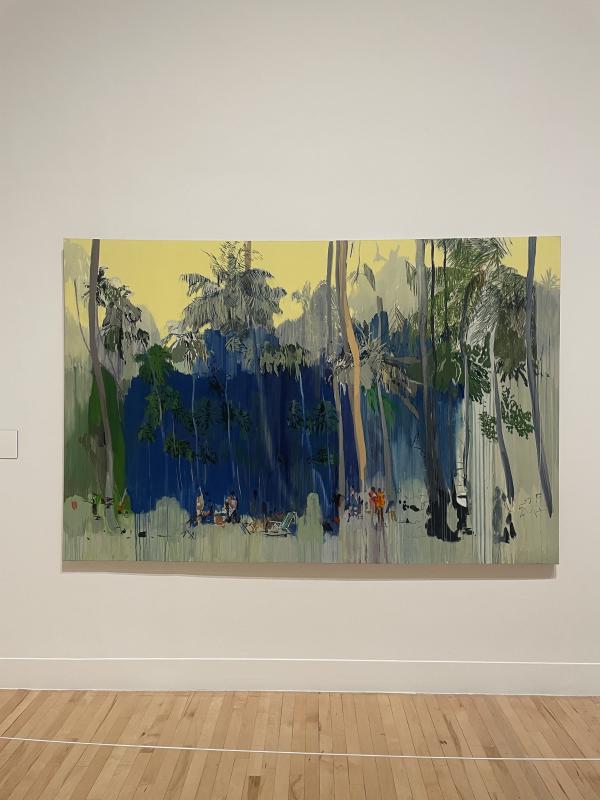
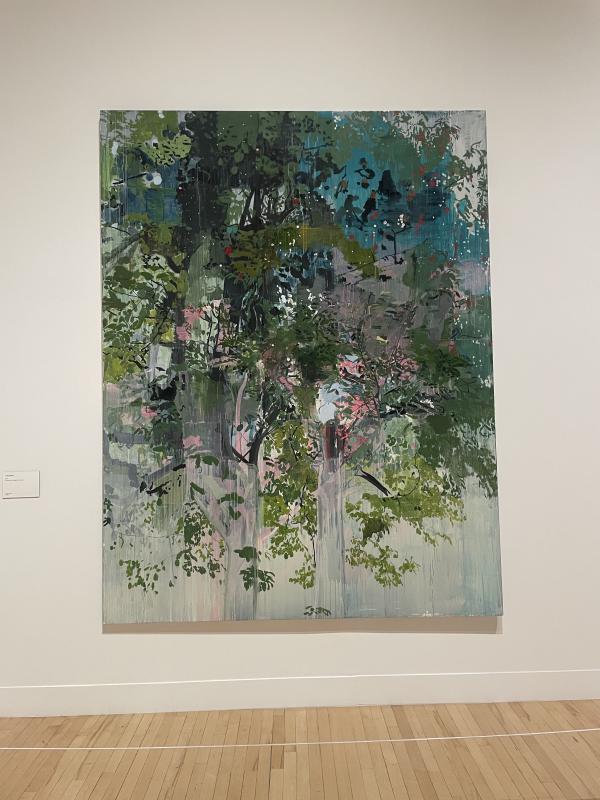
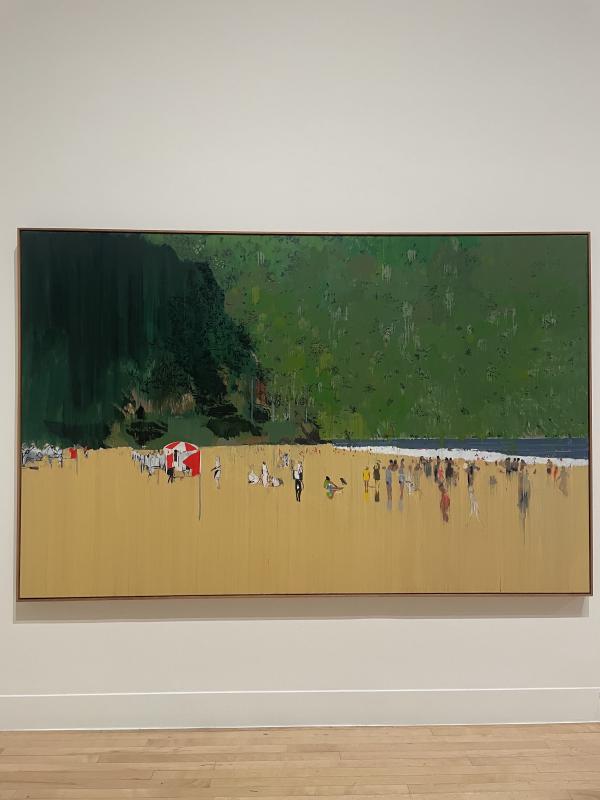
So, now. It is sunny May and I am standing in the Tate Britain looking at Hurvin Anderson’s paintings. They are landscapes, in a way. They are painted from photographs, in a way. But they are also painting as an adjective - painting-y, painting-ier, painting-iest. So painting, they obliterate the mythology of their own production. I can see the way he dissects an image. Depth is a matter of order. The image is a collection of shapes that exist on top of each other, but they interlock to the point of confusion. The image is a puzzle, you unlock it by rifling through the layers to figure out which one comes out on top.
Solid dripping green of the trees, blue sky, blue sea in a wash over grey sand, the neon pea green of the light and the murky khakhi of the trees. The wall text says something about haziness, looseness, spaces collapsing into themselves, nostalgia, history and diasporic distance. The paintings are blurred, they give you a bare minimum amount of visual information. In this way, Anderson holds the viewer at a distance, allowing them limited access to the world of his image. Or something like that.
On any other day, maybe I’d be in the mood to run with this. The painted subject’s right to unknowability, I guess. I don’t object to it. But today, it doesn’t feel true. The short course has ended (it was only a week) and now I am painting at my kitchen table — I am forced to the point of projection. I feel like I am seeing an image that someone has searched for with their painter’s eye, vision as a realm-to-be-mediated, rather than a truth that lands in your lap. There is a sensitivity in the space between the layers, in depth as a confusion of order.
I have this vision of Hurvin Anderson in his studio. Like a sorcerer, he cajoles liquid paintinto solid settled arrangements. Some alchemical transformation, it takes form in a way that fulfils his desires, but only because he asks nicely. Crisp lines and molten blocks of colour, the material has a mind of its own, but somehow the paint and the painter are one and the same. As it settles into some fully saturated solidity, it becomes a space he can then carve back into, carve out, embellish and bedazzle. He slips through layers, bending the laws of time and space, making shapes rub up against each other, interlocking them so they weave in and out. I am dizzy because on one level, I know how he’s done that (but on another level, it feels like a superhuman feat). In a language of similes: this painting is like a magic trick.
Hurvin Anderson’s solo show is on at Tate Britain until 23rd August