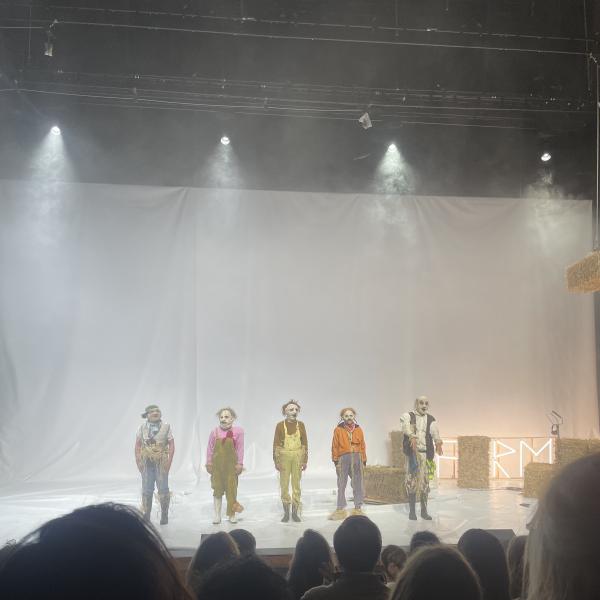
Farm Fatale
ZM
I was on my way to the Southbank Centre to see a play. It was last-last weekend, precisely, the Saturday. Tommy Robinson’s fanboys were clogging up the zone 1 pubs, St George’s flags tied around their necks like capes. All the way from Embankment, across the river, union jack st George union jack st George — tourist or fascist or y2k britpop revival? Spin the wheel. I was there to see a play called Farm Fatale.
A group of scarecrows in a field after the climate collapse, after all the birds have fled or died. They jiggle around on stage and tell us about the farms and farmers that made them. They tell us that they now run a scarecrow radio show — they play music (they’re in a band) and birdsong (because they miss the birds!!) and they interview the last bee in Europe. Then a giant egg plops out the back of an enormous furry mass. They show us the barn that they keep more of these giant eggs in. They spray the eggs with fine mist, the eggs glow. They serenade the eggs. They spy a farmer on the horizon, their next door neighbour. He is an industrial farmer — they hate him. They could kill him!!! But they don’t, they just scare him with the power of art.
I leave the theatre to look out at the river and think about how I have no idea what that play was really about, no clue what happened. Did anything happen? An egg was plopped out into the world, a bee was interviewed, the radio station continued to broadcast. My boyfriend booked the tickets and he tells me that he thought I would like it so much I would review it. It was a match with my taste profile: physical comedy, absurdist, surreal, a pocket of time in a mad speculative future that may (or may not) actually come about. But I dither. I tell him that I wasn’t sure if anything actually happened.
The story was kind of anti-climactic, there is no big blow out ending. They didn’t kill the next-door farmer! They scared him away with the power of art, and when they voiced this plan, I laughed out loud because I thought they were joking. (Narratively, not morally) murder is absolute/fixed/certain, the power of art is vague/undetermined/impermanent and unpredictable. I don’t think of myself as a traditionalist, but when it comes to narrative structures, I guess I am: I want a satisfying climax, a hero, an antagonist, I want a 5-act arc that ends in resolution. Last-last Saturday, on the Southbank, looking out over the river and the sea of flags — what I wanted was certainty.
On our way out, my boyfriend tells me that Ethiopian music is modal — it uses a unique pentatonic modal system. You group different notes into relation and ascend, descend, scaling like a ladder or bouncing between. It’s not necessarily about moving through different chord progressions, it is about relation: you stay within one chord system and move around in it. There isn’t movement, a line travelling from C to E to G, there is a stillness. But that’s not to say that nothing happens — as you bounce, you create new relations. Maybe then it becomes about the intervals, the space between the notes rather than the notes as fixed places. Maybe, in this modal-mode, you don’t have to find resolution. We come in and go out without fanfare and you can just keep going forever and ever and ever.
I tell him about Ursula Le Guin’s essay: The Carrier Bag Theory of Fiction. Joseph Campbell’s monomyth would have us believe that all stories must follow the same pattern. The hero’s journey: the hero goes out into the woods, the unknown, to find the holy grail (whatever that might mean). He struggles, he fights, he conquers, he triumphs, he returns home forever changed by his journey. The story is linear movement, out and in, and it is propelled forward by conflict. We, human-hunter-gatherers, understand our history origin and purpose through a particular lens that favours the grand sweep of this narrative arc. Violence! Murder! Conflict! We are biologically primed to go out, find mammoth, kill mammoth, bring mammoth home (and eat mammoth, forever changed by the satisfaction of red meat). The shape of the hero’s journey is satisfying because it mirrors the shape of human existence, or the course of human civilisation: violence, muder, conflict. Ursula Le Guin says: well, actually, no (lol). The first human tool or technology was not a weapon — not a spear a knife a blade or a club — it was a container, a sling, a carrier, a bag. Fuck that caveman origin story, that’s capitalism or colonialism or both: the myth of infinite perfect progress, man conquers earth, space, new markets, death, the future, changes the world and remakes it in his image. The narrative spear or time’s-(killing)-arrow mode of the Techno-Heroic. If we subscribe to the carrier bag theory: we are made to go out into the forest and find berries and nuts, put them in our bag, jostle them around, and bring them home. The scale is not as grand. But in the bag, maybe these berries and nuts bump up against each other. Maybe they change each other. Maybe, while bouncing around against each other in the bag, the berries and nuts are brought into relation and that relation makes possibilities that wouldn’t occur to us. Maybe — the novel and human history — is best understood as a practice of finding or facilitating possibility. A container rather than a line, a person rather than a hero. And the point of possibility is that it opens things up, rather than resolving it and closing it down. Come in and go out with no fanfare, jostling in the bag forever and ever and ever.
We talk and we move in a line (out). On the river bank, in the bar, on the platform of the tube station, out the corner of my eye I see a sticker on the tube sign. A St George’s flag but Reform turquoise blue and the words MAKE BRITAIN GREAT AGAIN. I scratch it off with my fingernails and my keys and I think about the country, and how I never really ever think about the country, except when I am allowing myself to catastrophise. I think about how the news is linear but not progressive, a narrative propelled forwards by conflict. Time’s-(killing)-arrow mode of the Techno-Pathetic. There is no beginning and no end, no resolution, only the jostling of items that never really come into relation and therefore never make possibilities — only potential disasters that unfold around us in slo-mo. And the disasters are genuinely endless, everything is bonkers and precarious: the government, the economy, human existence on earth. Maybe the news is the only truly groundbreaking narrative form. But heroic resolution, and our desire for it, still exists! Elon Musk wants to race to Mars or the stars, we think cavemen were running around taking lumps out of each other with big mammoth bone clubs. We want to affirm (to ourselves and others) that we are the hero of — maybe not the singular global, but at least our own — story.
Stories are meant to help us make sense of things that defy sense-making — of course we want resolution (a 5-act narrative, a small red man saying muslims are ruining the country, knowing what’s best for the country full stop). Resolution is a kind of answer and deep down we all expect things to make sense (eventually).
So then, on the District line, what does it mean, to refuse resolution? If you take something like SCARECROW CIVILISATION AFTER THE CLIMATE COLLAPSE and present it to us in this non-linear modal way, in and out with no fanfare, no hero, no beginning and no real end — what am I meant to do with that? How am I meant to make sense of it? My boyfriend looks at me and says, you know there was no bee, there was no next door farmer? I blink at him, confused. The bee they interviewed didn’t exist, the evil farmer next door and the farm itself didn’t exist. It’s all after the climate crisis collapsed into an apocalypse, nothing is alive. The scarecrows are playing or pretending.
My eyes finally glaze over, and I retreat to an inner world, the place I go to to make sense of things. Because: I want resolution, I want the 5-act structure, I want sense to be found or made. I have expectations of stories, and my expectation is that there is meaning or purpose or something like resolution at the end of it. Spear or carrier bag, if possibility is opened up, I stilll expect it to lead somewhere. I guess I also expect that somewhere to be a finite, resolved end-point. But if my boyfriend is right, and those scarecrows were going mad in their field, pretending to interview a made up bee for a radio programme broadcasting to no one, because there are no bees left because all the bees and all the potential listeners died — then there is no fixed idea of sense or meaning or resolution or possibilities, no stakes for these things to be found.
I expect art and culture to provide me with meaning, resolution or possibilities because the real world is so empty of those things. If my boyfriend’s plot twist is right, then Farm Fatale was too much like reality for me to feel satisfied — but my own lack of satisfaction is so interesting to me. I can say all these things in a neutral way: modal music and carrier bag fictions, no fixed places like beginnings or endings and no fanfare between. Of course fascism is appealing: it rises up in times of bonkers precarity and plays on our desire for resolution, certainty and meaning. We desire those things because they make us feel like there might actually be an end point to all of this! But if my boyfriend is right, and those scarecrows are still playing around with pretending, bouncing around and relating and still making possibilities even though there’s no point (no beginning no end and no audience to witness it all), then — what are we meant to make of THAT?? Is it even possible to purge yourself of that desire for certainty, recalibrate yourself so you expect and are satisfied by a modal-mode? Is that optimism or is that the bleakest thing you’ve ever heard?
Farm Fatale was on at the Southbank Centre and it was written by Philippe Quesne