
Crisis Acres
Gabrielle de la Puente
It’s a Wednesday afternoon and I’m sipping water. Dizzy, and it’s continuous even though I’m only sitting at my computer. I’ve started new medication to lower my stomach acid and this one side effect has been waves around my feet all week. All the way up. Waves knocking gently around my shoulders, like I’m in a crowd of people even when I am alone.
So dizzy, but I tried a low acid diet for a while there and it didn’t stop my throat from burning. The bit between my stomach and oesophagus isn’t keeping a lid on things and the stomach acid is still crawling up. Still scratching at a part of the body it’s never supposed to see. I still need help. Still wish the Long Covid clinics hadn’t been closed last year. Still, still, still.
I put in a request for an appointment via my GP’s online platform and kept my phone on loud for a week but didn’t hear a thing. I then called even though the physical act of speaking is starting to feel physical, only for the receptionist to tell me she hadn’t had anything through. I did eventually see a doctor and I’ve got the pills and I’m dizzy now, aren’t I, but that small failure is what I am thinking about today having just watched Crisis Acres, an hour-long film by the artist Tom K Kemp.
Sometimes artists email Vimeo links and passwords and I immediately forget about them, but after I reviewed Melania last week, I can’t bear the thought of writing about mainstream culture knowing my criticism helps create the mainstream, and that mainstream creates this stale world. I’m going back through emails to find art instead. It’s not like I can stand up right now anyway.
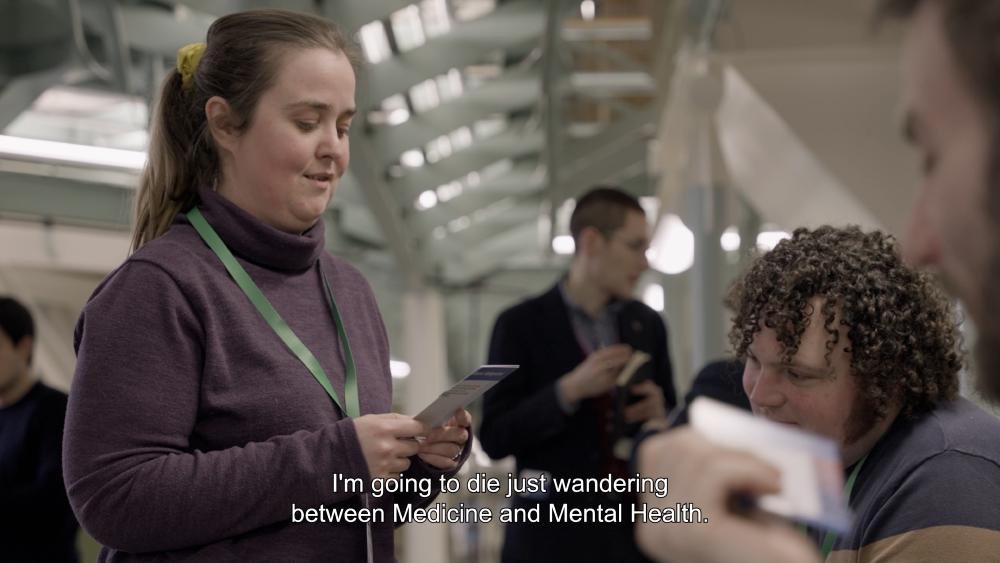
In Crisis Acres, the artist has invited people to role-play the different departments that make up a hospital. Some of the participants are healthcare workers, some aren’t. One group of players are patients and they each have cards around their neck telling them details of their character and how sick they are supposed to be. Groups are sat at tables in a big echoing space inside De Montford University, and we follow patients as they are moved between these different departments, going table to table asking for help and direction.
It’s improvised. Somebody plays the role of the media and starts asking if any of this is even working, and there’s a lot of fretting. An air of general confusion. Not enough money. Not enough staff. Not enough beds. Then, at the end of the film, a patient is told by two doctors they can treat her but first they ‘need to roll a five or more.’ We watch a six-sided dice hit the table. The doctor rolls a five and celebrates. ‘Good news, good news! The medication is working.’ We understand then that the entire past hour has played out according to the roll of the dice.
I don’t imagine much of my audience has experience of tabletop role-playing games but generally speaking, there’s a challenge that players try to overcome, but how well they do depends on the number they roll. The dice creates the drama, chance creating the thing everyone improvises around. So for example, a five helped that patient in the film, but if they’d rolled a one, it might have meant an allergic reaction that landed her in A&E or something.
I like that the artist has applied a luck-driven game system to healthcare. It’s embarrassing how well they match up. Devastating how, for all of us unable to afford private healthcare, the NHS has us beholden to a system we have no control over. The postcode lottery; your position on a waitlist; that 8AM race for appointments. The lottery in the gender and race of your primary doctor. How much knowledge and imagination and energy the doctor has in the three minutes you get to speak.
As the film went on, I found myself thinking of all the times I’ve asked a question and watched the doctor’s eyes flick left to the computer so they can refer to the script the system has told them to read from. But what if the answer’s not there? I don’t want to ask the Internet instead, when grifters are waiting to sell snake oil and right-wing politics. I either enter into the system and agree to play by its rules, or what, I lose the game?
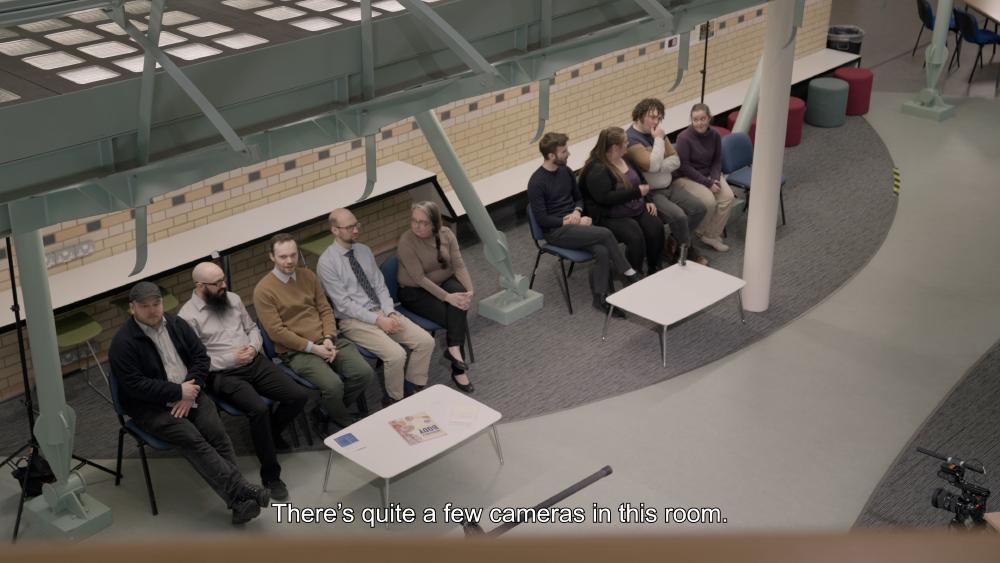
And there are other systems, of government, money, and law. Power organises all these different systems with a rigidity so that they seem to structure the sky. They structure time. How we move through our days. Old institutions, fossilised. Honestly the world is structured so luck no longer feels like luck but something more sinister. Against this context, Kemp’s film does that neat art-trick of presenting an institution we are familiar with but here it is one step removed and the film exists in the displacement, between the world there is and the world there could be; the burning throat and the one where I can speak forever.
I can’t say I enjoyed watching it, but I don’t think enjoyment is even close to the point. I’m interested in games that aren’t about enjoyment because that’s another displacement, when by and large we expect games to be fun. I mean, we expect healthcare to make us feel cared for but that’s so rarely the case as well. I think this is why, when the doctors rolled the dice at the end of the film, I wished those dice calls had punctuated the entire film, explicitly. I wanted the film to be more up front with us, less clever, arty, social experiment and more obviously criticism. But I would say that. I’m a sick critic.
When the credits rolled on all the participants’ names, I closed the tab and looked at documentation of the film when it was exhibited at Two Queens last year. There’s a video of a sculpture that was shown in the space alongside the film. In ‘Homonculus,’ there’s a big clear tank full of six sided dice and something inside is making them churn ever so slightly. Moving out of the way, falling over each other. There’s soft clinking sounds and constant movement so the dice rolls never come to an end.
I started scrolling down the press release but the words moving on the screen were enough to make me dizzy again, and it was strong enough that my body leant forward as if I was going to fall into the computer. It’s more than a dizzy spell. This is vertigo. I took some more water and wished I could roll the dice myself. These days, maybe always, it feels like someone else gets to roll it for me.
🎲🎲🎲🎲🎲🎲🎲🎲🎲🎲🎲🎲🎲🎲🎲
if you’re here at the end of the review please leave a 🎲 dice emoji on our instagram so i know you were here 🎲 sign up to our patreon at 1 pound a month if you want to support another year of writing 🎲 plus then you get to join our discord
a note after publishing: just found out the game the participants play in the film is Unnamed Hospital Game by Rob Grayston