Camino de Santiago
ZM
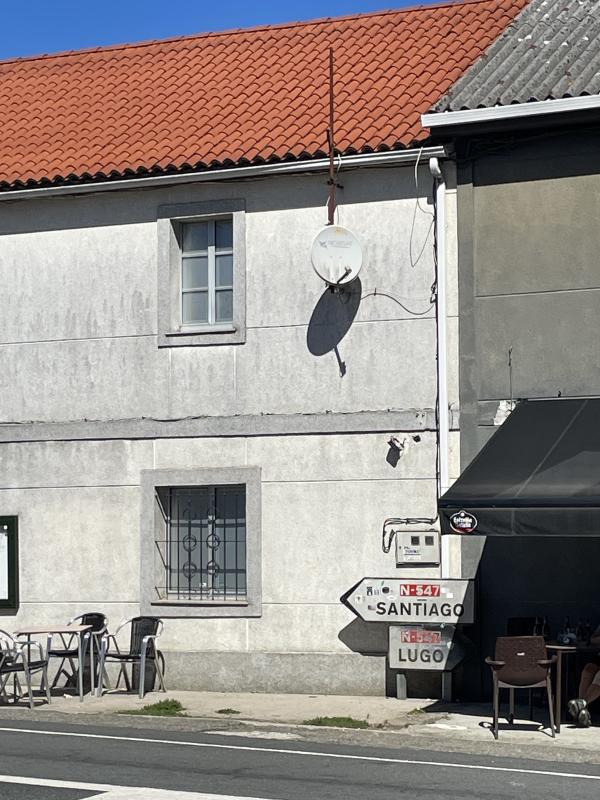
I am in a courtyard restaurant in Sarria, at a long table with a man from Argentina and eight women from all over the world. We are drinking Rioja and talking about how much we love Wikipedia, we are talking about the gorillas in Rwanda’s mountains, we are talking about God. It is Sunday. We are 111km from Santiago de Compostela. We will walk for six days along the Camino Frances to the Cathedral.
One woman says that people have been walking this way since Before Christ (BC). The paths run over ley lines, following old Roman trade routes, at night the milky way lights up and points the way. Apparently, the Spanish call the Milky Way el Camino de Santiago. In Medieval times, they thought the stars were made by the dust kicked up by the pilgrims as they passed through. Back before Columbus sailed over the Atlantic, back when the world was flat, they thought this edge of Galicia was the furthest West it was possible to go. People walked this way thinking they were walking to the end of the earth.
Talking about God, I realise that no one at the table is particularly religious. We talk about God like God is an elemental force, the same as wind and gravity. We talk about God like he is our fake boyfriend. We talk about God and we smirk, just a bit, because none of us believe in a man with a big beard sat in the clouds. But then, I don’t know what we’re all doing here. Because we are off on an old Christian pilgrimage.
Under the Cathedral’s altar, there’s a sepulchre. There, they keep the body of St James the Great, one of Jesus’ twelve disciples, the first apostle to be martyred.
When Jesus died, rose and ascended to heaven, the apostles dispersed, left Jerusalem and went in different directions to preach the gospel of the new Messiah. Peter went to Rome, Thomas went to India, Jude went to Lebanon, and apparently James went to Spain. When James was in Zaragoza, the Virgin Mary appeared to him in a vision, calling him back to Jerusalem where he was beheaded by one of the many King Herods.
But, legend has it: his decapitated body was picked up by angels and placed in a stone boat. It sailed without a rudder or a sail, across the Mediterranean, through the Strait of Gibraltar, up the Atlantic coast of Portugal to Padrón (where they make those little peppers). His disciples in Spain came to pick him up and approached a local Galician Queen to ask her where they could bury his body. She sent them to a cave that was also a hellmouth, guarded by a dragon and two massive bulls. They showed them the Holy Cross and the bulls at least were tamed at the sight. They took the body of the apostle to a forest, and buried him where the bulls miraculously stopped.
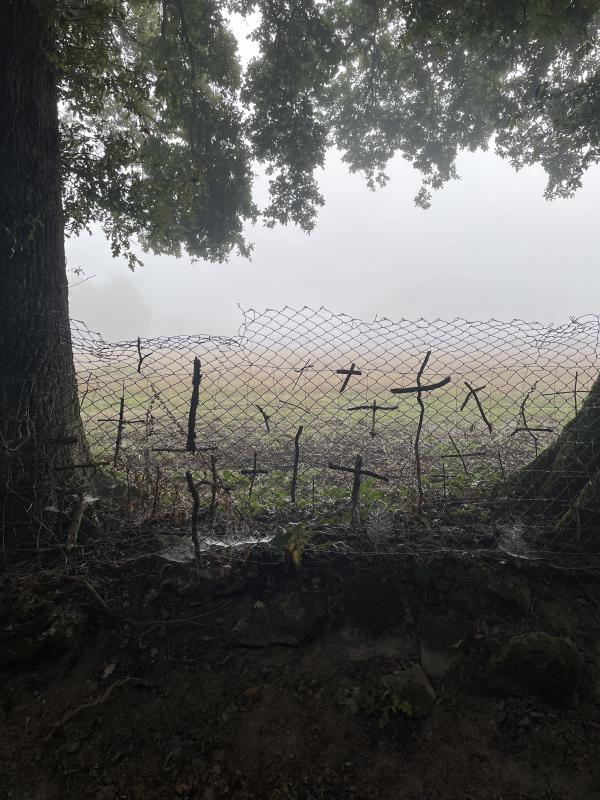
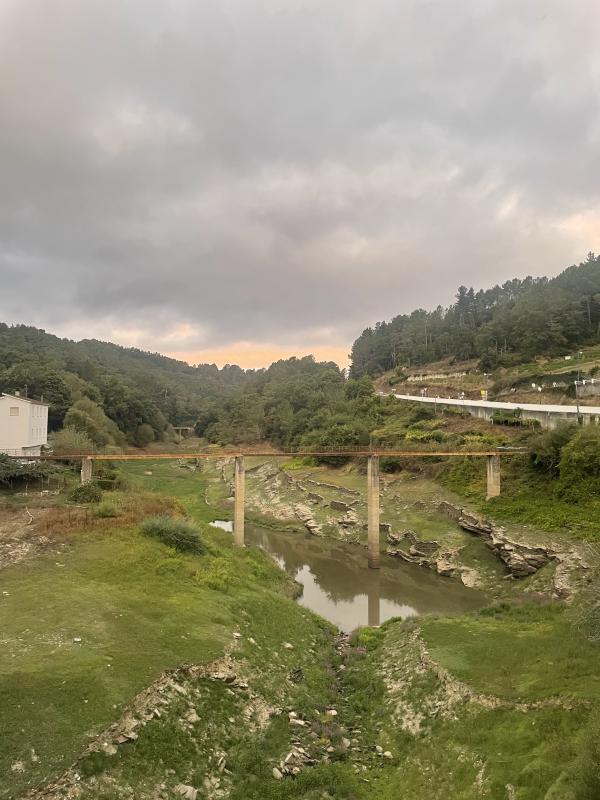
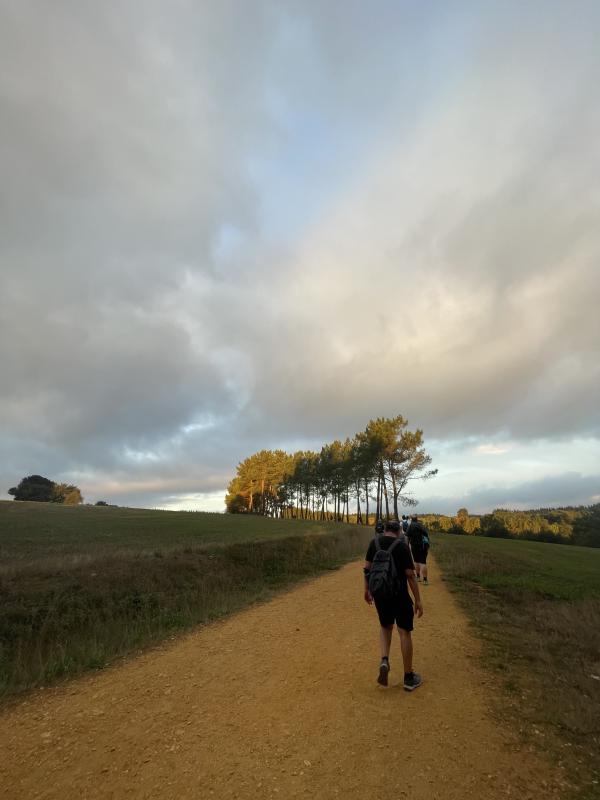
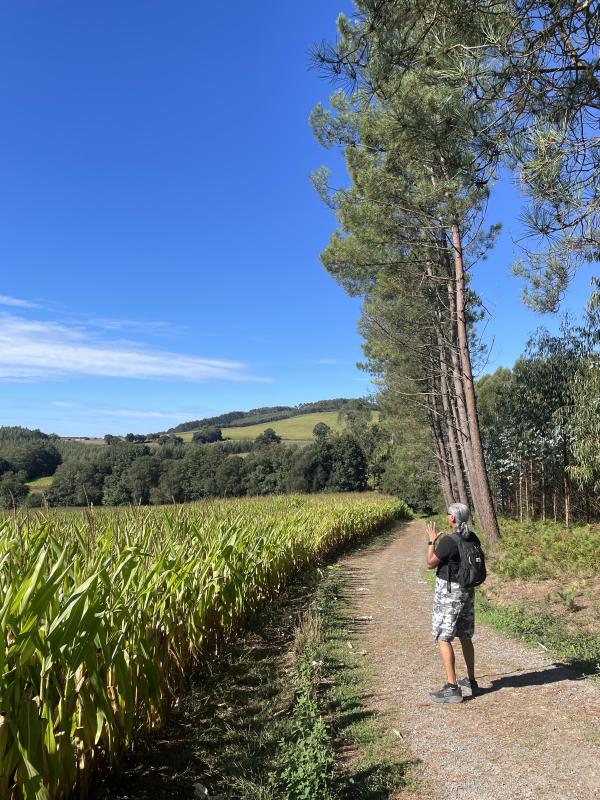
Now it is early Monday morning, still dark and we are walking out of Sarria, through fields and cow country. There is fog low over the grass, dew slick over the gravel and the woodland floor. There are horses, cows, chickens and goats. We buy scallop shells to tie to our backpacks, a pilgrim souvenir that people take home as proof of their journey. We stop for bocadillos, which turn out to be massive footlong sandwiches. By midday the sun is nuclear, I can feel the ground-heat through my shoes. When we get into Portomarin, three of the women in our group are already at the bar, god knows how. They tell us that there’s something going on in town. They saw a brass band in Hawaiian shirts and priests parading a statue and a cross through the square. The Argentinan man says it’s the Feast of the Holy Christ of Victories — the statue is from the Church in the square, they’re celebrating faith’s victory over sin and death. Later, I sit on the steps of the church, drawing and drinking Tinto de Verano. My Mum smokes a cigarette that smells like cornflakes. We talk to a woman with bright red hair, from North Wales. We listen to Mass in Spanish and then we listen to the brass band playing Mexican folk songs. We watch teenagers make gooey eyes at each other, negotiating dances with strangers.
That night, I dream that the world is small, about the size of Old Street roundabout. I am on the very top of it, walking along with my backpack and cap. My steps turn the world, or I am a passenger on the treadmill of the world. Nothing else happens, I just walk. I watch myself from above, a drone’s eye view. The sky is so blue, the birds are cheeping, my legs are so strong and I watch myself as if I and the world are in a snowglobe, walking and walking forever.
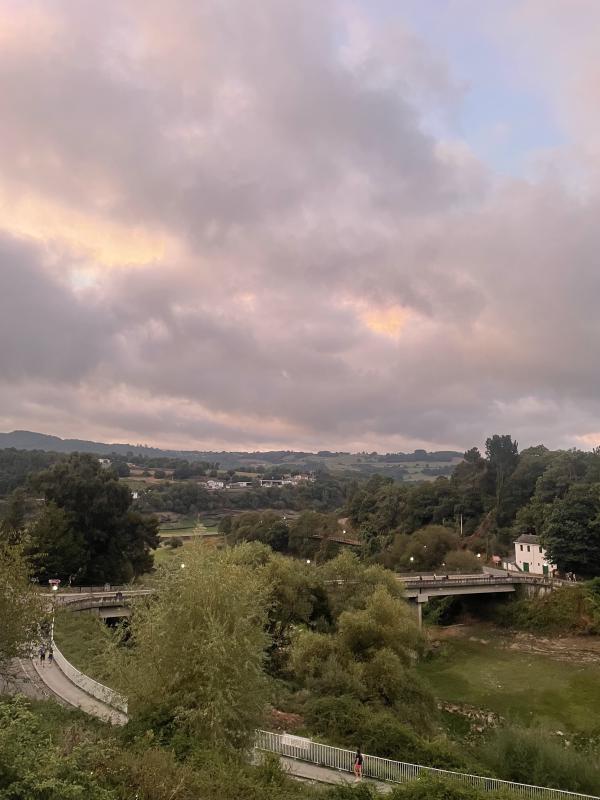
On Tuesday we leave at sunrise. Everything is purple and silver and I see the morning’s golden hour. By midday it rains so hard that it seeps through my mac, my baseball cap, through two tshirt layers, my bra, my shorts, my socks. I am clammy, cold and squelching. The only bit of me that’s sore is the top of my foot, where it connects to my shin. I didn’t realise there was a muscle there, I have never used it this much. We walk over an Iron Age hillfort, its stone walls are still standing. Miles of mud, up and down rolling hills with tarmacked paths. We stop for a tortilla at a petrol station and it is boiling hot, delicious, one slice is the size of a small dog. We walk 25km. We realise that there is such a thing as a shoe dryer, and the place we’re staying in Palas de Rei has one in every room. This time we drink bottles of Albariño, a white wine from Galicia that tastes so acidic and sour, it’s almost salty.
I dream I am crawling up a mountain on switchback tracks. I see the face of the mountain as a two-dimensional facade, like a theatrical backdrop. There is nothing behind, or off to the side. It sits in a translucent bubble, me and the mountain are the only things that the whole world contains.
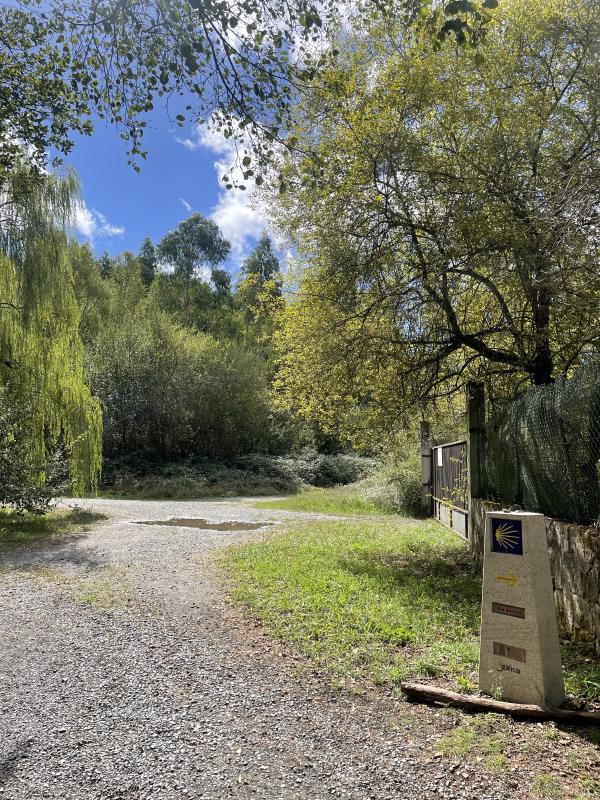
On Wednesday we walk through squares, down the side of motorways. Before we set out, we collected booklets called credencials, pilgrim passports to stamp along the way. This is hardcopy proof of your journey. If you walk the last 100km into Santiago, and collect a minimum of two stamps a day, you qualify for a certificate called a compostela. Stamps are issued at hostels, cafes, bars, churches and shrines. Sometimes people just set up stalls along the route and charge a Euro for homemade DIY stamps. I run into the Pilgrim police, they are stamping passports on the bonnet of their 4-by-4. I walk past a pianist playing a Casio keyboard in the forest, and collect a stamp with musical notes. A couple are giving out free apple juice to pilgrims in the woods, and stamping passports with a stamp in the shape of a coptic cross, carved out of a wine cork. We stop in a church, and I light a candle for my sister and for Gabrielle, who is halfway across the world, at the actual end of the earth. We stop in a shrine where there are wax casts of arms, legs, babies, dogs and a pair of disembodied tits. We walk through industrial estates, yards where they’re salvaging car parts, stripping them down to scrap metal. We stop in a town called Melide, I drink six kalimotxos (half red wine half coke) and stumble back to bed in the darkness of a new moon. I do not dream, or if I do, I don’t remember.
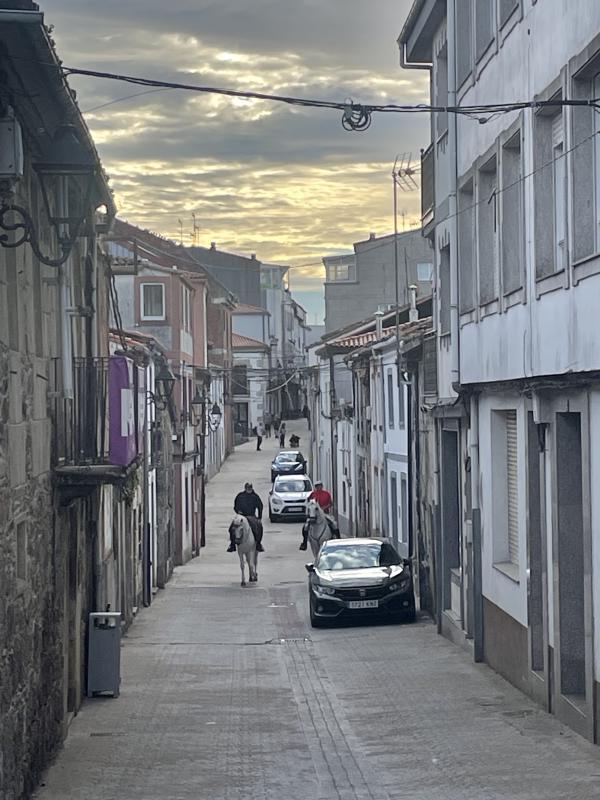
On Thursday we walk out of town and see riders on horseback. I check my credencial, there are four options for mode of transport: pie (foot), bicicleta (bike), silla ruedas (wheelchair) and caballo (horse). The Argentinian man tells me the word caballeros means horseman, gentleman, knight and men’s bathroom. He tells me a Spanish dad-joke is to ask for the bill in a restaurant by asking for la dolorosa, the suffering or the misery. We stop in a Medieval church with frescos of God on a throne with a crown. Winged angels blow trumpets off to the side, with tight round cheeks. We walk through woodlands and villages, past fields of corn being grown for pig-feed. I see geese in a yard, kittens so small they look fresh out of the womb. Graffiti on side streets that reads PUTA ESPANHA, FUCKING SPAIN in Portugese. We stop in a town called Arzúa and eat paella and cheese. In the town square there is a statue of Juan Manuel Vidal García, alcalde martir de Arzúa, the martyred mayor of Arzúa. When the Spanish civil war kicked off, the fascists quickly captured Galicia and purged its towns of civic leaders (and all the communists, socialists, anarchists and republicans) that opposed them. Vidal García had built schools and empowered the trade unions, when Franco’s forces piled into Arzúa, he was captured, taken to Santiago and executed. Every year, the town honours and remembers him and all other martyred rebels, laying flowers by his statue. I light a candle for them too, in a chapel where a choir of old women with lace collars over their tshirts are singing from battered hymnals.
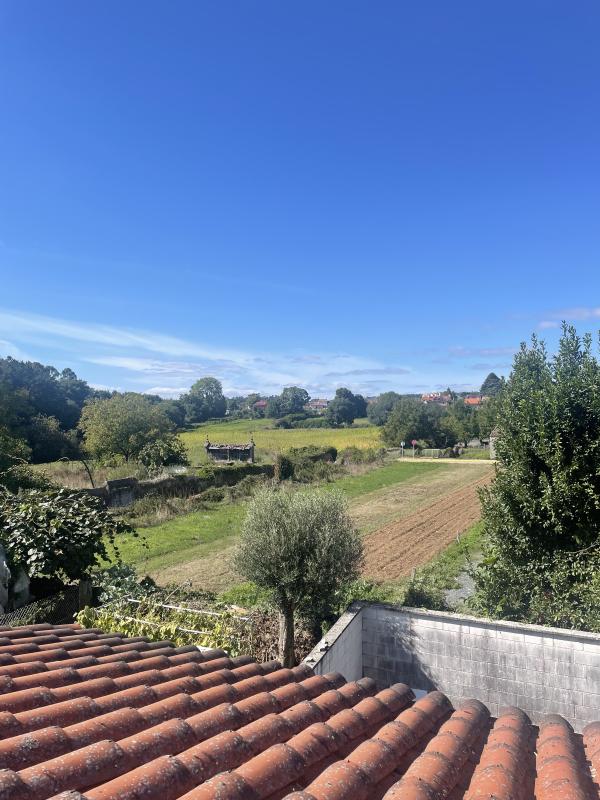
On Friday we walk through woodlands, past a sewage treatment plant and chicken factories, through highway underpasses and up hills that never seem to go down. I have moved through and past any muscle soreness, but the balls of my feet are pale white, bloodless and itchy. The forest feels old in a way I can’t qualify, all towering oak trees, chest high ferns and eucalyptus trees. We walk past a group of men playing the bagpipes at the same time, in a harmonious racket. This part of northern Spain is literally where ancient Celts came from. They sailed from here, up the coast of France to Brittany and then across the Channel — to Cornwall, Wales, or over the Irish Sea to Ireland. They shared culture, mythology and folklore, shared trade routes, they built the same standing stone structures (these are dotted around the hills and forest we’ve been walking through). Celtic Galicia was mostly obliterated by Rome, but in the 1800s, there was a Romantic revival of this heritage (it was highkey political: Galician intellectuals were forging a distinct regional identity at a time when Spain’s new queen was trying to unify, standardise and centralise power in Madrid).
We stop at a little village behind Santiago airport, called O Aminal. I watch the planes flying in low as we sit in the courtyard drinking Radler (Spanish shandy, or ¡cerveza y limon!). One of the women in our walking group shows me a photo of the statue of Jesus in Burgos Cathedral. It is famous for its greusome body horror — there are gaping meaty gashes where the nails sit in his feet, his body is bedazzled with polka dot wounds that are all weeping three identical trickles of blood. He sweats and bleeds from his wounds in Holy years, his hair and fingernails have to be trimmed because they literally physically grow.
The body horror appeals to me, I am feeling my body and its use in a way that I have no reference for. I cannot eat enough literal calories to keep my body fuelled for walking, I am fatigued on a cellular level because of my stomach’s max capacity. I get into bed and fall right asleep, completing the phrase out like a light because it really is like I am flipping an off-switch. I have spent so long outside: walking all day, stopping for coffee and Valencia cakes and tiny little beers in cafe gardens, eating dinner in squares and courtyards. When I do come in to sleep or piss, I feel like an animal, like a horse that’s got inside. The rooms are too small or I am too tall and lumbering to move gracefully. All my clothes smell like dust and sweat, damp and heat, and I can’t wash the smell of myself off me. I am experiencing the horror of corporeal existence every time I climb to the top of an uphill path and look ahead to find another incline waiting for me.
But at the same time, I feel the miracle of being in a body. Getting in a plane, a train, a bus or a car — these are modes of movement that crunch space down, collapsing it into itself so one part of the world feels largely the same as any other. I leave Gatwick, whizz through the air and land in Madrid, Paris, New York or Taipei. I only remember that I am on the other side of the world when I open Google Maps and swipe over green/blue/grey expanses, measuring the distance between where I am and my home. Even then, the distance feels hypothetical. Walking slowly over Galicia’s hilly landscape, this is a mode of movement where my body is meticulously measuring space in real time, life sized. I am carving into it with every step, space is something I am immediately stuck within, a present tense I am forced to negotiate for 23 consecutive uphill kilometers until I can stop for the night. I am experiencing a sickening comprehension of how truly enormous the world is, a fucked up sublime that has nothing to do with the eucalyptus forests or the rolling fields.
This is the first time I think properly about my body, exertion and space. For the most part, I’ve been preoccupied with other things. At some point, up some hill on Monday, I realise that I can just start talking to people. Strangers, everyone, anyone moving slow enough for me to catch them.
I speak to two old women from county Armagh, they have two hiking poles each and they are steaming up a hill like they’ve got engines. They tell me they’re popping a paracetamol or an ibuprofen every two hours, just preventatively, because the hills are a devil on the hips at their age. I speak to a man from Veracruz, Mexico in wraparound sunglasses. I show him my 35mm point and shoot, he shows me his jarg Chinese GoPro on a little handheld gimble. I tell him I’ve seen cigarette lighters bigger than his camera, and he lets me have a go on it — it really does shoot in 4k. My camera is actually the star of the show, an old Japanese man from Milton Keynes stops me mid-shot and asks where I get film developed nowadays and I Airdrop him locations on Google Maps. He gives me a plastic ziploc bag to protect my camera from the rain. I speak to a woman from Rio who tells me she is used to the hills because she lives in Edinburgh now. She teaches me how to order drinks in Portugese. I speak to a Dutch guy who has walked 99 days from Amsterdam. When I ask him why, he winks and says I have nothing better to do. A German guy who has walked from Freiburg — through the Black Forest, over the Rhine, ACROSS FRANCE, over the Pyrenees and into Spain. The full journey would take him 110 days, or 2500km. I tell him that I think he is insane and he laughs all the way up the rest of the hill, as if to prove my point.
Sometimes I run into the same people taking the same route as us. A couple from Bombay, the woman with red hair from Llandudno and her childhood best friends, two girls from Dublin who have horses, a Mum from Melbourne who assures me that Australian wildlife is not so bad (I do not believe her), a man from Turin, a man from Ravenna, a girl from Sicily who now lives in Barcelona and a group of lads from Granada who insist on walking single file (so I can only ever speak to one of them at a time). I ask them about the Alhambra, they tell me that Atlantis is thought to be a corruption of Al-Andalus — or the other way around, my Spanish listening skills are very bad, so I couldn’t tell.
I find myself in these situations because my Mum is booking it over the hills at lightspeed, ripping off the plaster as quickly as possible or trying to outrun her own joints, I can’t tell. Everytime I stop to take a photo, I look over and find she has made it to the bottom or top of the hill and is waving at me like I’m the slowpoke. A woman in our walking group says she got chatting to two women from Pune and they said we’ve just seen the funniest thing, this old woman and her daughter, the daughter is always stopping to chat and the old woman is walking so fast, the daughter then has to run like a maniac to catch up with her!
But I love it! I love to stop and chat with people in the queue for loos and cafes, love to turn round and yap with strangers at a bar. Every night I am last to bed because I’m talking to the girls from the walking group and Lionel Messi’s biggest fan about something or nothing. The woman from Texas tells me about the Mennonite church she volunteers at. Before she left, the pastor gave her a piece of paper with 10 spiritual questions to contemplate printed in a cursive font — I copy them into my sketchbook. How do I turn back towards others and share what I’ve seen // how do I receive what they have discovered? The woman from Los Angeles tells me that, being Jewish, it is part of her religion to argue. She must question every received wisdom, hold it all up for critical inspection. Discussion is more important than being correct, the process of engagement creates nuance, understanding, flexibility. Faith shouldn’t be punitive or cumbersome, it is a living thing that we make by engaging with each other. In conversation, we keep traditions alive and we learn to tolerate each other, even when we disagree.
My Mum thinks the Spanish are party animals, thinks being in Spain is making her a party animal too. Everyone getting together to drink and eat and chat. This is just a more convivial and sociable culture — all cultures are convivial, except the bastard English. The English hate each other, my Mum thinks. The English-speaking world has a more individualistic understanding of society, I think. It is a white, Anglo-Saxon, protestant, capitalistic, colonial, conservative thing — to keep yourself to yourself and build cities and towns in a way that ensures everyone else does too. It leads to a kind of social derangement, I reckon. People really do yearn to be with each other! Or at least, I yearn to be with people. I want to live for a thousand years, speak to everyone, see everything, go everywhere, listen and learn and think and make and — I’d have to have a thousand years MINUMUM to squeeze all of that in. Yes, I think, we are only vessels. We must pour stuff in, swirl it around and pour it back out — transfigured. Experiences, conversations, sights, I don’t think they become real until they pass out of me in some form — in writing, in conversation, in turning out some kind of meaning. I am just a vessel! A walking lump of meat — thinking and speaking and listening. This, in and of itself, is a miracle.
I meet a priest from Manchester and ask him a series of questions that are too nosy to be polite, but he humours me. He says being a priest is, to use art terminology I might appreciate, like being an icon. He is obviously a human man, but he also functions as a symbol. People project their relationship with the divine onto him, they look at him and they see (he scare quotes with two fingers) our invisible friend. I laugh, but that must be a weird way of experiencing the world. He shrugs, says he gets to cut right past small talk, see people at their most human, the essential core of what it means to be alive — I am jealous of him for being in on a secret that I don’t know about. He says priests have to justify their vocation a lot, to their bishop or just among themselves. Most people say they’ve experienced a calling, a moment when God cleared his throat and told them YOU SHOULD BE A PRIEST. But he never had that. He can’t pin down a specific moment of thinking I want to be a priest, but he never didn’t want to be one, couldn’t imagine not being one, it is just something that makes sense to him. As he walks away, it occurs to me that I know exactly what he means. (Being a writer is a weird way of experiencing the world, I get to think about how weird it is to be alive and, of all the things, it just makes sense.)
No one in our group is religious, but we do always end up talking about God. Argentinian Dad says humans like to feel superior but at the end of the day, we are just fucking animals! Two sisters from Belfast, raised Catholic. The older sister says when we die, we rot, that’s it! so we should spend our brief time alive eating as many cakes as we can. The younger sister isn’t so sure. She doesn’t go in for the point system for good behaviour, even if we’re walking a pilgrimage that counts as an indulgence (with our compostelas we get to cut our time in purgatory short). But maybe the institution is what feels like fiction. Wouldn’t it be a shame to die and just be dead? Maybe God isn’t a man with a big beard and a crown, sitting on a throne in the clouds. Maybe God is unfathomable, maybe heaven is beyond human comprehension, complete alterity or some sci-fi dimension in the stars. The woman from Chicago says her Mum told her heaven was a massive Blockbuster video store, with a video for anything you’ve ever wanted to know. You just track down the tape, put it in the machine and there you go — immediate satisfaction of your curiosity. When I was a kid I imagined Allah as a giant in a cloak with a shiny green diamond shaped face, wearing red lipstick and a pointy hat. My Dada told me that in heaven, if you wanted an apple, all you had to do was think of an apple and a branch would grow towards you and deliver the juiciest reddest apple right into your outstretched hand — immediate satisfaction of your desires. We all agree: the stone boat story is ridiculous, and hell is an airport where all the flights are delayed.
That night I smoke an actual full fat cigarette and dream about walking a precarious gravel path. There are gaping holes the size of storm drains lurking down in the ditches, and I teeter on the edge with every step. I feel myself slipping down, into the ditch, into the hole, sliding into the void. I reset on the path, regain my balance and walk on, only to lose my step again when the next hole comes around. I fall, I disappear, I recover, I reset, I continue. I walk and am woozy with the dizziness of falling. The next day I tell the group about my dream. I say I’m psychic, and I’m going to stack it, watch and see.
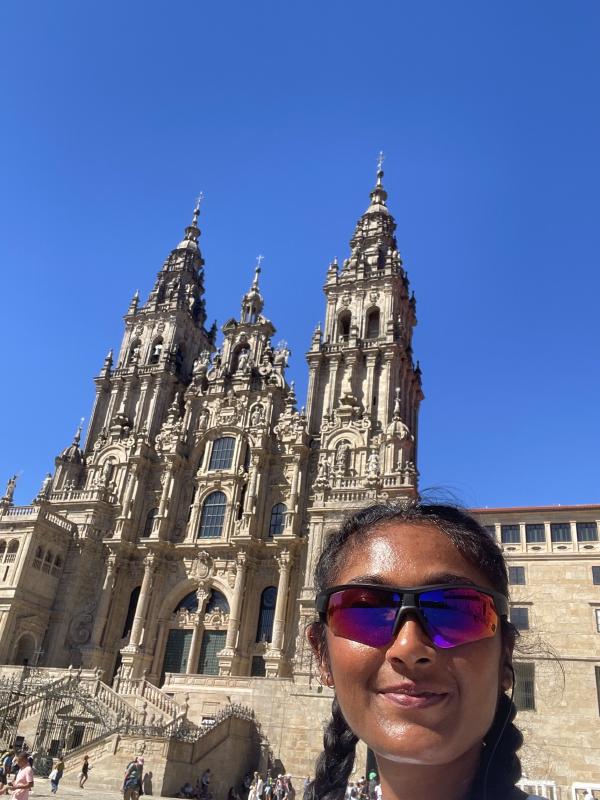
On Saturday we set out early and walk past the airport tarmac to the city’s limits. Finally downhill, through a park, where we can see the spires of the cathedral in the distance. Over a motorway and onto cobbled streets. My mum is limping, I carry her stuff, I do not fall. It is 38 degrees, blinding heat, we are half-delirious. Following the gold scallop shells set into the pavement (or the holes they’ve been prised out of, for a souvenir). I see the spires up ahead, there are tears in my eyes, a man is playing bagpipes down a side staircase and the sound is blasting off the stone, everyone is rushing through. We come out into the square squinting at the light, I turn to face the cathedral and I cry.
I think I should walk for six days or 100km or to the end of the world (whichever comes first) to get to anything I want to see, anywhere I want to go. I am looking at the cathedral and crying under the western sinking sun. Because this is a physically measurable kind of satisfaction. Because people made this with their human hands, with their chisels and with their sweat, ye olde stone masons with their workshops in this square. Because people come to see it, walking from home with their two human feet. Because here I am, so insignificant and small, a speck of sand in the crowd over the hills and the centuries. And I am glad! Glad for my smallness, glad to be here where people are, thank God!
Because even though I feel like an animal, I don’t think that’s what I actually am. Chimps go to war, inflict pain for pain’s sake and torture each other. AI has discovered altruism, self-sacrifice for the collective good. But humans make things, for the glory of god or to show each other or for their own satisfaction. Cave drawings, zigzags on bone fragments, cathedrals with stone facades that face the setting sun, whatever — we made religion, if you believe Voltaire, we made God. If we inflict pain for pain’s sake, we made God and morality to make us feel bad about it, to stop us from doing it, to grant us forgiveness if we promise to never do it again. Whether God exists, whether we are fucking animals, who cares! The mystery is the point, we don’t know, we think, we make, we give things meaning and they exist. In this scenario, I think God is other people. God is what we owe to each other, the bonds between us, the yearning we feel to be together, chatting about anything, everything — cameras, stonemasons and kalimotxos, paracetamol for the devil in your hips, Veracruz, Amsterdam, Sicily and Turin. God can only be the sublime, a scale bigger than a single individual, so God must be somewhere in the crowd, somewhere in the space between us that we can measure with our bodies. No point system, no admin, it is irrational. It is feeling, spirit, energy, the stars, the ley lines or the Milky Way.
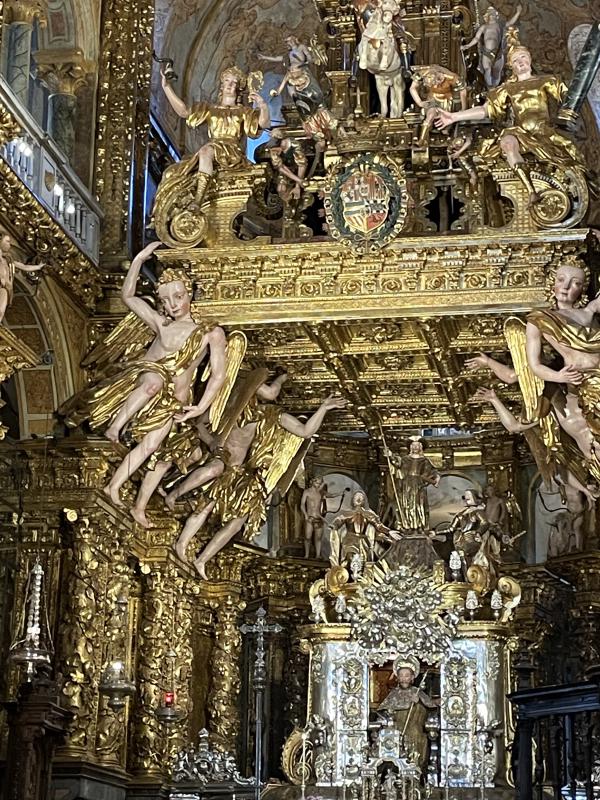
We go into the cathedral, down into the sepulchre and up to hug the statue of St James from behind. I light a candle for my sister, for Gabrielle at the end of the world. We go to the only curry house in town and now it’s my mum’s turn to cry, because she hates Galician soup and they do kofta here. We go to a bar with a fountain under a marquee and tattoo artists set up under floodlights. The next morning we go to mass and the priest says ‘WE DO NOT LIVE FOR OURSELVES, WE DO NOT DIE FOR OURSELVES, GOD FORGIVES US SO WE CAN FORGIVE EACH OTHER’ and I cry again, because I really do think God is other people, or the space between us. I think about Eid jummah and the aunties that stand at the front yelling LADIES, STRAIGHTEN THE ROWS until we’re so close we’re touching elbows and lined up toe-to-toe. The closeness is meant to keep our hearts in sync with each other. The organ blares above us, huge angels the size of jumbo jets hanging over the altar. The men sat behind us are from Naples, they walked the English way from Ferrol, they tell me I’m the first English person they’ve met on their journey. I shake their hands and feel calluses, heartbeats. My Mum vows that she will never walk again, God as her witness. We get on the plane and space collapses into itself beneath us. I walk home from the station in the purple evening. Everything is silver, nothing has changed but it feels different. I have shrunk or the city has grown two inches, there are strange prisms in my eyes and all the light is being refracted in unfamiliar ways. My keys in the door, bag on my back, I honk like a dog. There is the robot hoover, there is my boyfriend who kisses me and tells me I stink. And here I am, tiny and changed, feeling like a horse that’s got inside.