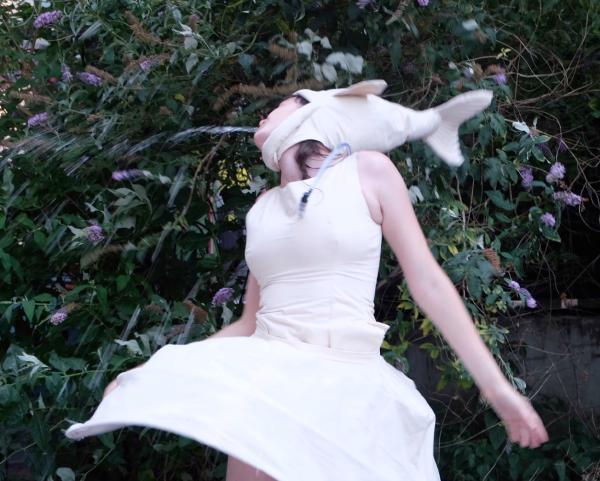
public displays of fluidity
Zarina Muhammad
since the beginning of the year i’ve been keeping a running list at the back of my diary, A READING LIST, where i keep track of my own little personal theory curriculum (because i feel like i am At A Stage In My Life where i need more words/concepts to think about the world with, more words/concepts than i am personally capable of producing, so now i must outsource that to theory). The first thing i wrote down was Mikhail Bakhtin’s Rabelais and His World.
in this text (that i’ve not actually read yet, despite all my best intentions), Bakhtin talks about the Carnivalesque and the Grotesque. The Carnival is a kind of social institution, a folk festivity, it happens because people want it to happen (not just because it has been officially sanctioned). it has a symbollic function, a sensuous function, there is also something about the role of laughter and like – on a sociopolitical scale, what is comedy??? you know what i mean? but from my initial googling (again, have not read the thing), bakhtin analyses the carnivalesque and identifies 4 things that feel sticky. 1: it dissolves social barriers/hierarchies and brings unlikely people together, closing the distance between them. 2: it dissolves social expectations around behaviour, the eccentric or the inappropriate are encouraged, everything gets looser and more permissive. 3: symbollic dualities (heaven/hell, high/low, big/small) come together and play out. 4: it dissolves the strict rules of piety, our understanding of what is sacred and the power of the sacred kind of melts away. There’s that Medieval tradition for the Feast of Fools, where a young boy would be chosen to parody the actual adult bishop, dress up in his robes and go round the town blessing people. obviously the church hated the Feast of Fools, condemned it and tried to stamp out the practice, but – it was so popular, people loved it, it was so much FUN! – it took the church centuries to eradicate the practice.
The whole thing is really interesting to me because i have this fascination with the figure of the fool / the jester. the way the jester can be the only person in the court that says ‘THE KING’S AN IDIOT!’ because it’s a joke, and the fool is a fool, and he’s inside and outside, and the social rules about behaviour don’t apply to him, and the strict rules of piety don’t apply to him, and he can bring those symbollic dualities together and make them play out – in Poor Artists, Quest goes to a fancy art party at the King’s Royal Court and is handed a jester costume because she, an artist, is the fool in that situation – but a royal fool, the guy that gets to be inside and outside and she gets that jester’s privilege to be the one that gets to say ‘THE KING’S AN IDIOT HA-HA-HA-HA!’ – i think artists and jesters and folkloric tricksters are very archetypically aligned. i think that is partly the point of art (??!! maybe), to perform those 4 carnivalesque functions – to take us outside/inside, to bring us together, dissove social expectations, handed down ideas, rules around piety – you get it.
i say that last point (about the point of art) lightly, because it feels like my own baggage. i don’t want to be that Guy that projects all their repressed desires onto some poor painting that is just trying to do its own thing. Not all art fits the bill, but most of the art i really like can be boiled down to these carnivalesque functions. it becomes the lowest common denominator (in a good way), the logic binding my taste together. i love the carnival, it seems. so when i run into art like this, that fits this particular bill, i come here rushing to tell you all about it.
here’s what i’ll tell you: Claire McMichael’s Public Displays of Fluidity is a piece of interactive performance art, where the artist is embodying an ornamental water fountain. They’re dressed in a sculptural white dress, with a hat in the shape of a fish. They have a camelbak water hose piped around their back. They are standing in a paddling pool with frills around the edges. the audience is gathered around as they dance. At first, slow. they move their hips, swirl, whirl, balletic. Then they flourish! a hand, a pointed finger. then they spit a mouthful of water out, aiming it at the nearest person. Cheeky. it’s cheeky! it’s playful. it is also toeing the line of what is socially acceptable behaviour. if this happened on the street, there’d be bloody murder. in the weird wild west of a gallery, host to a performance artist, there’s laughter.
As I’m watching it on youtube, i think of those enormous turbocharged dancing water fountain shows at disneyland, outside las vegas casinos. the ones with the lights and the classical music, the ones where everyone goes ‘OOH’ and ‘AAH’ like it’s the fireworks, where everyone claps at the end. i have dreams sometimes that i am a whale and i live in the boating pond in the middle of victoria park, but people are glad to see me because i shoot enormous jets of water out of the top of my big dark slick wet whale head. the swans swirl around me, graceful. somehow McMichael is taking these things and shrinking them, blowing them back up, making a comedy that collapses the social boundaries, the expectations around behaviour, our rules about the sacred (or even the beautiful), a symbollic duality: high/low, spectacular/funny, beautiful/gross. i imagine the water spit out of the artist’s mouth would hit you and feel warm with the heat of their cheeks.
They say (don’t they?) that we laugh for one of two reasons: recognition and surprise. recognition: when someone says something that feels true, accurate, when someone identifies something we all do or maybe we individually. surprise: the thing we least expected to happen, we laugh in delight at the bizarreness of being alive. I laugh more often in surprise. I love a clown, a jester, a fool, a carnival, an ornamental fountain that has no function, other than ornamental comedy.
see documentation of Claire McMichael’s ‘Public Displays of Fluidity’ on their website here // here is a little photo if u cannot click thru »»